
-

-

-
 PT | EN
PT | EN 
What if Europe’s future power no longer lies within its borders–not in Brussels, Berlin, or Paris–but in Surabaya, Dakar, Bangkok, or Salvador?
It is an uncomfortable question for a continent long accustomed to imagining itself as a center. Yet in today’s fractured world, it may be the most realistic one Europe can ask.
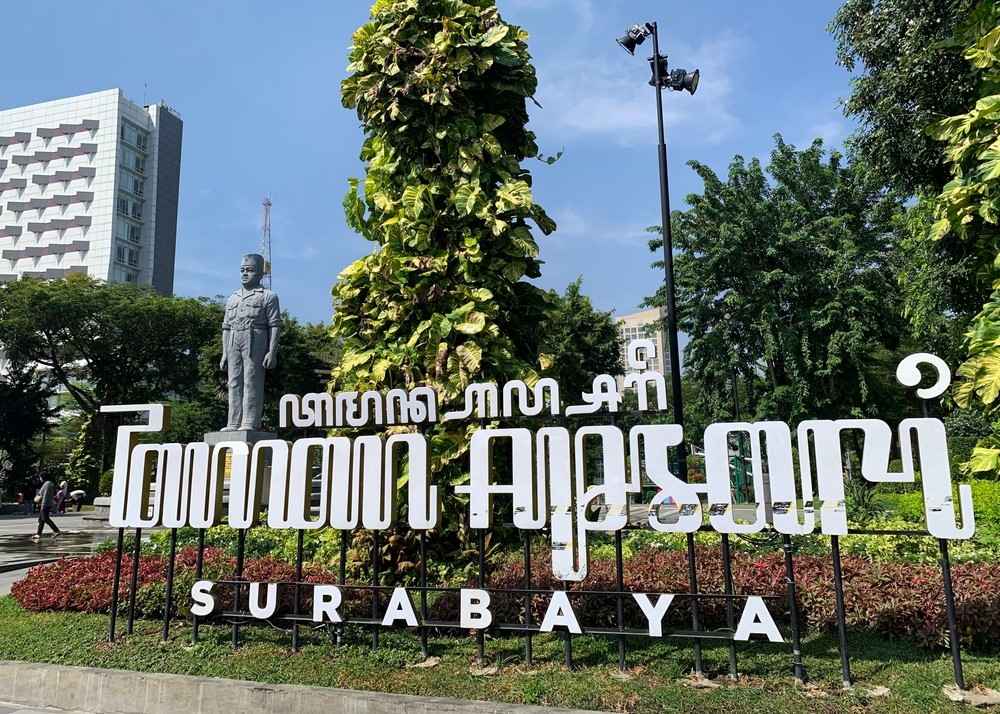
In the summer of 2024, something unusual happened in Surabaya, Indonesia’s second-largest city. For four intense days, a global conference escaped the walls of the university. Classrooms spilled into neighborhoods; academic panels turned into public conversations. Artists, activists, religious leaders, local officials, students, and scholars from more than 70 countries gathered not just to exchange ideas, but to experiment with producing knowledge together.
The themes–rivers, housing, heritage, public health, urban inequality–were not discussed in the abstract. They were debated where they unfold: in kampungs, cultural centers, and public spaces across the city.
This was not a conventional academic conference. It was a conference-festival–a “ConFest”–designed to blur the boundaries between academia and society. And it may offer Europe an unexpected lesson at a moment when its global role is increasingly uncertain.
The Surabaya experiment did not come out of nowhere. It grew out of more than a decade of collaboration between Indonesian institutions and partners across Asia, Africa, and Europe. What made it distinctive was not just its scale–more than 2,000 participants–but its direction of travel. Knowledge did not flow from North to South. It circulated. It was co-produced. And it was grounded in local realities.
That distinction matters–especially now.
Europe faces a strategic dilemma. The transatlantic alliance upon which it framed its global position looks increasingly fragile. The United States appears to be turning away from the Eastern Hemisphere, while increasing political shifts erode the idea of a unified “West.” Meanwhile, countries across Africa, Asia, and Latin America are actively reshaping the world order–through BRICS, regional coalitions, and quieter, society-driven forms of cooperation. Bottom-up social movements across these regions, often connected to counterpart communities in Europe, have built dense transnational networks with a growing appetite for deeper knowledge exchange.
In this emerging multipolar world, Europe’s traditional tools–trade agreements, development aid, diplomatic summits–are no longer sufficient. What Europe increasingly lacks is not expertise or resources, but trust-based legitimacy in the eyes of Southern societies.
This is where knowledge diplomacy comes in–not as a slogan, but as a practice.
Unlike classic diplomacy, knowledge diplomacy is not primarily State-driven. It unfolds between universities and neighborhoods, researchers and artists, city officials and civic groups. It depends on long-term relationships rather than short funding cycles. And when it works, it treats partners not as recipients of expertise, but as co-creators of solutions.
It also goes beyond the narrow scope of “science diplomacy,” often focused on technology and the hard sciences. Knowledge diplomacy embraces a broader, more inclusive understanding of knowledge–one that includes the social sciences, the humanities, the arts, and indigenous and practice-based forms of knowing.
That this shift is not merely theoretical became clear on January 30, 2026, when the International Institute for Asian Studies convened a roundtable in the Netherlands entitled “Repositioning Europe’s Knowledge Collaboration with the Global South in a Fast-Changing World.” Bringing together a diverse group of European knowledge actors–with the Vice-President of the European Parliament, Younous Omarjee, as guest of honor–the discussion revealed both a growing awareness, and a lingering unease within Europe’s own institutions.
Participants wrestled openly with questions that echo the Surabaya experience: How can Europe move beyond inherited North-South frameworks toward genuinely reciprocal partnerships built on lived experience? How can the strategic value of knowledge collaboration be articulated in a multipolar and multifaceted world? And what kinds of long-term political and institutional support are needed to sustain such efforts?
What emerged was not a single blueprint, but something arguably more important: a shared recognition that knowledge collaboration can no longer be treated as a peripheral or technical activity. At a time of profound geopolitical transformation, creating spaces where policy makers and knowledge actors can think together–patiently, horizontally, and across difference–is becoming essential.
Europe is, in fact, unusually well positioned to pursue this path–precisely because of its complicated history with the Global South. Colonial legacies cannot be undone, but they have produced deep linguistic, cultural, and human connections that still shape everyday life on both sides. Diasporic communities across Europe, and European communities across the South, are living bridges: often overlooked, too many times politicized, but strategically invaluable.
The Surabaya ConFest showed what becomes possible when these connections are taken seriously. It created a multi-centered knowledge community that did not orbit around Europe, but included it as one participant among many. It replaced hierarchy with reciprocity–and generated something increasingly rare in global politics: enthusiasm.
Similar experiments have followed. In June 2025, an Africa–Asia ConFest was held in Dakar, Senegal, bringing together universities, artists, civic groups, and international partners to engage around shared concerns–from geopolitics and education to well-being and diasporic experience. Like Surabaya, the event unfolded across the city as much as on campus, fostering direct connections not only between African and Asian participants, but also with contributors from Europe and beyond.
Other such initiatives can be more locally focused yet globally relevant. In Nairobi, in August 2025, civic and academic actors from four continents worked with local partners on community-based responses to river flooding in densely populated informal settlements. The policy strategy developed for the Kenyan capital became equally valuable to participants in their own cities. Through shared experience, free from the vertical experts-led North-South cooperation model often promoted by the EU, they formed a durable knowledge collective on “river cities,” transcending geography and specialization.
These experiments may seem modest compared to grand geopolitical strategies. But their impact is cumulative. Networks grow. Trust deepens. New collective imaginaries take shape.
And there are precedents worth recalling. Japan’s decades-long postwar engagement in Southeast Asia–combining infrastructure, education, and cultural presence–built enduring regional ties and transformed Japan into one of the most trusted partners in the region. The United States, before the Trump era, pursued its own version of knowledge diplomacy through the Peace Corps, Fulbright exchanges, and cultural programming. Many of these initiatives are now under threat, which only underscores the unique opportunity for Europe to step in.
Global influence today is built as much through classrooms and cultural spaces as through ministries.
A credible European knowledge diplomacy must therefore be civic rather than purely intergovernmental; long-term rather than project-based; and horizontal rather than instructional. It must accept a difficult reality: the Global South is no longer looking for models to import, but for partners to think with.
The prize is significant. In an uncertain global future, Europe can soon become known not as a lesson-giver, but as a listener; not as a gatekeeper, but as an inclusive connector; not as a nostalgic power, but as a credible, respected partner.
In today’s fragmented world, the most radical diplomatic act may simply be to sit down, in someone else’s city, and think together.
* The events in Surabaya, Dakar, and Nairobi were facilitated by IIAS and partner institutions from the Global South. The recent policy Roundtable, was organized by IIAS at Leiden University.
Submitted: April 1, 2026
Accepted for publication: April 2, 2026
Copyright © 2026 CEBRI-Journal. This is an Open Access article distributed under the terms of the Creative Commons Attribution License, which permits unrestricted use, distribution, and reproduction in any medium, provided the original article is properly cited.
