

-

-

-
 PT | EN
PT | EN 
The essay examines the origins of what became known as the Monroe Doctrine, in US President James Monroe's Address to Congress in December 1823, aimed at discouraging intervention by Spain and other European powers in the Western Hemisphere. After lying dormant for more than 70 years, it was invoked against Great Britain in the Anglo-Venezuelan crisis of 1895. It was then extended in the Roosevelt Corollary (1904), the Kennan Corollary (1950), the Reagan Corollary (1980) and now the Trump Corollary (2025) to justify, in varying circumstances, US intervention in Latin America.
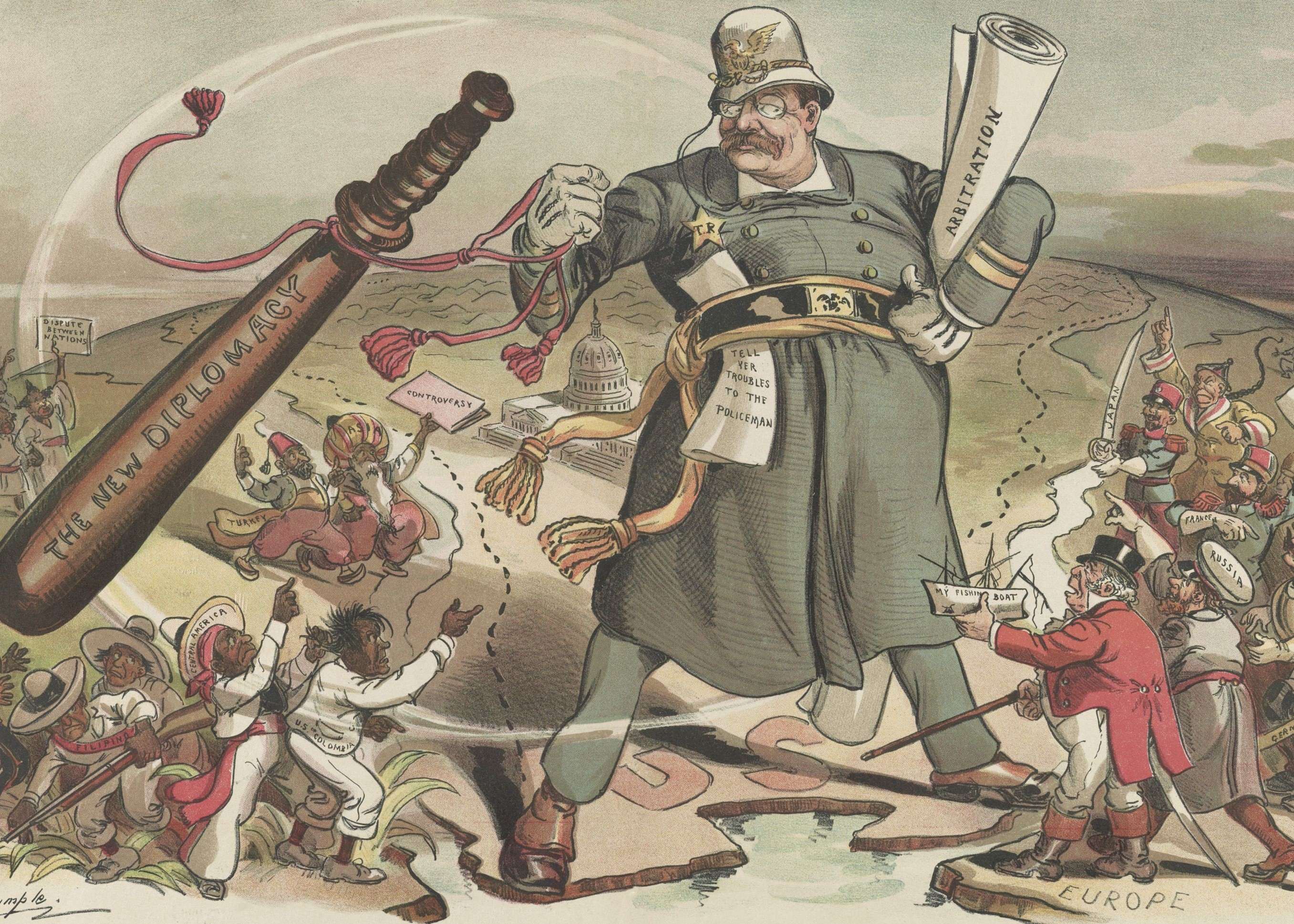
December 2023 marked the 200th anniversary of what became known as the Monroe Doctrine, the passages in US President James Monroe's Annual State of the Union Address to Congress ( December 6th, 1823), in which he declared that the United States would oppose any political intervention by a European power in the Western Hemisphere. The Monroe Doctrine, in its original formulation, was invoked in Secretary of State Olney's warning to Great Britain during the Anglo-Venezuelan crisis of 1895 and, by extension, to justify political intervention in the Western Hemisphere by the United States itself, in Roosevelt's Corollary (1904), Kennan's Corollary (1950), and Reagan's Corollary (1980). Absent since the end of the Cold War and the removal of any Soviet/Communist threat to Latin America which might demand US intervention, in November 2025 the Trump Corollary to the Monroe Doctrine was given a prominent place in the National Security Strategy of the second Trump administration. It was then invoked to justify US military intervention in Venezuela on January 3rd, 2026, threatened US interventions in Cuba, Mexico, Colombia and Panama, and even US annexation of Greenland. This essay examines the origins of the Monroe Doctrine and the role it had played in US-Latin American relations during the past two centuries.
The continental landmass on the other side of the Atlantic Ocean (or, if you prefer, the two landmasses joined at the isthmus of Panama), “discovered” by European navigators at the end of the 15th and beginning of the 16th centuries, was first given the name “America” in 1507: in a book entitled Cosmographiae Introductio by the Alsacian humanist and scholar Matthias Ringmann at the Gymnasium Vosagense in Saint-Dié -des-Vosges and in an engraved world map Universalis Cosmographia by his colleague the German cartographer Martin Waldseemüller. The name honored the Florentine navigator Amerigo Vespucci whose unreliable claim to have been the first to make landfall on the coast of what is now Venezuela in 1497, that is to say, before Columbus in 1498, was widely believed at the time (though not for long). The name America survived through use by later 16th century cartographers, notably Gerardus Mercator.
The continents of North and South America (from the middle of the 17th century also referred to as the “Western Hemisphere”) were occupied and settled, and the indigenous (“Amerindian”) populations conquered or subdued, first by the Spanish and Portuguese and then by the British and the French. The History of the Discovery and Settlement of America by the Scottish historian William Robertson (1777a, b), Principal of Edinburgh University for thirty years, was the first history of America, North and South. Its main focus was, however, on the Spanish Empire in America.
In 1776 the 13 English colonies on the eastern seaboard of North America declared their independence. Thomas Paine, in his pamphlet Common Sense (1776), was probably the first to suggest that the United Colonies of British North America should adopt the name United States of America. There was no debate, no formal resolution, the name emerged through use in drafts of the Declaration of Independence (June-July 1776), the Articles of Confederation (1777, ratified in 1781) and the Federal Constitution (1787, ratified 1789). Thus the United States appropriated for itself the name America. And the United States doubled its size with the Louisiana Purchase from France in 1803 and the absorption of Florida by treaty with Spain in 1819.
In 1808 Thomas Jefferson, one of its Founding Fathers and the third President of the United States, welcomed the incipient revolutions for independence in Spanish America. The dissolution of the Spanish Empire in America would be a further step towards the eventual exclusion of all European influence from “this hemisphere” (the Western Hemisphere). America, the New World, would be totally independent of Europe, the Old World. In the following years, as the Spanish Americans fought for their independence, Jefferson and other prominent US politicians, notably Henry Clay, senator for Kentucky and later Speaker of the House of Representatives, elaborated the idea of an “American system”. It would be based on a special relationship between the peoples and governments of the Americas, a shared American geography and history, and shared American ideas of republicanism, liberty and democracy (sic). And Jefferson included Brazil, not independent from Portugal until 1822 and not to become a republic until 1889, as a key element in his “American system”.
John Quincy Adams, on the other hand, Secretary of State in both the Madison and the Monroe administrations (1817-25), while equally opposed to European influence in the Americas, had no interest in any “American system” which included former Spanish and Portuguese colonies. They were, in his view, not only Iberian and, worse, Catholic, but inherently unstable and degenerate, unlikely to be able to establish and maintain free liberal institutions. “As to an American system”, Adams wrote, “we have it; we constitute the whole of it”. He had “little expectation of any beneficial result to this country [the United States] from any future connection with them [the newly independent Spanish and Portuguese speaking countries], political or commercial”.
By 1822 the United States was ready to recognize a number of de facto independent Spanish American republics. But there remained a concern that, having restored Ferdinand VII to absolute power in Spain, Bourbon France and the so-called Holy Alliance powers (Austria, Prussia and Russia) might even now attempt to restore Spanish power in America, which would in turn threaten the stability and security of the United States. In December 2nd, 1823, in his State of the Union Address to Congress, President James Monroe included a few paragraphs relevant to this issue which later in the 19th century became known as the Monroe Doctrine. Monroe declared that “the American continents (sic), by the free and independent condition which they have assumed and maintain, are henceforth not to be considered as subjects for colonization by any European powers”. Any attempt by a European power “to extend its political system to any portion of this hemisphere [the Western Hemisphere]” would be seen as “dangerous to [the] peace and safety [of the United States]. We could not view any interposition for the purpose of oppressing them [the independent States of Spanish America] or controlling in any manner their destiny, by any European power in any other light than as the manifestation of an unfriendly disposition toward the United States”.
This was a rhetorical declaration. Monroe and his Secretary of State, John Quincy Adams, were well aware of the limits of US power. The United States had no capacity to defend the new “American nations” against hostile European powers. But they also knew that France was not seriously contemplating intervention in Spanish America. Even more important, as early as 1817 Britain had made it clear that the Royal Navy would not permit any European power to intervene on the side of Spain in the Spanish American revolutionary wars. By 1822 Britain was also preparing to recognize the de facto independent republics and protect its growing commercial and financial interests in Spanish America. In August 1823 George Canning, the British Foreign Secretary, had proposed to Richard Rush, the US minister in London, that Britain and the United States should jointly warn France and the other European powers off the Western Hemisphere. As President John F. Kennedy wrote in the speech he was due to give in Dallas on the day he was assassinated ( November 22nd 1963): “It was not the Monroe Doctrine that kept all Europe away from the hemisphere–it was the strength of the British fleet and the width of the Atlantic Ocean” (Smith 1994, 112).
Canning realized that it was his proposal to Rush that had in part made it possible for Monroe to include his remarks on America and Europe in his Address to Congress. “The line of demarcation which I most dread”, Canning wrote in December 1823, “is America versus Europe. The United States naturally enough aims at this division!” But Britain's overwhelmingly superior political, naval and commercial power ensured that, for the independent Spanish American States, British recognition was far more important than US recognition. “Spanish America is free and if we do not mismanage our affair she is English”, Canning wrote to Lord Granville, the British ambassador in Paris, in December 1824. “The United States have gotten the start on us in vain; and we link once more America to Europe”, he wrote to his friend John Hookham Frere in January 1825. With the recognition of its independence from Portugal meditated by the British in August 1825, Canning secured British political and economic preeminence in Brazil as well as in Spanish America. “And so behold!”, he wrote to Granville in November 1825, “the New World established and if we do not throw it away, ours” (Bethell 1970). In South America at least, the 19th century was the “English century”.
Simón Bolívar had a vision of a confederation of Spanish American republics forming a “single nation”. In December 1824 he invited representatives of “all the peoples and governments of America” to a Congress in Panama “to arrange our American affairs”. He did not, however, initially include the United States (which he felt should be kept at arm's length), Haiti (former French colony independent in 1804), and Brazil (former Portuguese colony which had declared itself an independent Empire in 1822). The previously skeptical John Quincy Adams, from January 1825 sixth President of the United States, was now in favor of the United States taking a leading role in hemispheric affairs. But when the United States was finally invited to Panama, it proved too late to send delegates. The Panama Congress, June-July 1826, was in any case a failure. Not all the Spanish American States sent delegates, and only Gran Colombia ratified the treaty of perpetual alliance. The idea of a Bolivarian American confederation persisted, however. American Conferences were held in Lima (1847-8), Santiago de Chile (1856), Lima (1864-5) and Caracas (1883: the centenary of Bolívar’s birth), but they also have to be counted as failures. And neither the United States nor Brazil was invited to participate. “[Both] are tacitly considered as not belonging to the American community”, wrote the Brazilian chargé d’affaires in Santiago in May 1862, “and consequently excluded from it or, at most, only tolerated” (Santos 2003, 97).
For sixty years after Presidents James Monroe and John Quincy Adams, no US President showed much interest in the Western Hemisphere. The isolationists, led initially by Andrew Jackson, Adams's successor as President, won the battle against the American internationalists. The focus was the Manifest Destiny of the United States to expand its territory across the continent of North America to the Pacific. This was achieved through the annexation of Texas in 1845 and the Mexican-American War (1846-8), as a result of which Mexico ceded to the United States over half its territory, including present-day California, Nevada, Utah, most of Arizona and parts of New Mexico. In warning against any meddling by the European powers in US expansion westward, President James K. Polk made brief reference to the Monroe Doctrine. But there was no invocation of the Doctrine against, for example, British and French intervention in the Rio de la Plata in the 1830s and 1840s, Spain’s annexation of Santo Domingo 1861-5 and its wars with Peru (1864-6) and Chile (1865-6), and even, most significantly, the French occupation of Mexico (1861-7). The Lincoln administration did not recognize Maximilian, installed as Emperor of Mexico by Napoleon III, and after the Civil War US military and diplomatic support for Juárez was a factor in persuading the French to withdraw. But the United States never explicitly argued that French intervention in Mexico was a violation of the Monroe Doctrine.
In the final decades of the 19th century, US governments began to show a new interest in the Western Hemisphere. The West was largely settled. The economy was booming and there was growing interest in trade with the countries South of the Rio Grande. There was also increasing concern that the “new imperialism” in Europe could pose a threat to the Hemisphere. James G. Blaine, US Secretary of State in 1881 and 1889-92, was largely responsible for the success of the International Conference of American States held in Washington D.C. (October 1889-April 1890). The United States invited the “nations of the Western Hemisphere”, the “nations of America”, including the Empire of Brazil (which became a republic in November 1889 during the Conference), to create an informal alliance. The Conference was to be followed by the negotiation of reciprocal tariff agreements to reduce trade barriers between the United States and the “Latin American nations”[1].
Soon after, in 1895, the Anglo-Venezuelan crisis over the frontier between Venezuela and British Guiana led to the first invocation of the Monroe Doctrine by the United States in decades. Attempts to settle the dispute during the 1870s and 1880s had all failed. Venezuela increasingly appealed to US politicians and US public opinion for support. In October 1894 William Lindsay Scruggs, a former US minister to both Colombia and Venezuela, who was hired as a special agent by the Venezuelan government, published a pamphlet entitled British Aggression in Venezuela, or the Monroe Doctrine on Trial, which proved extremely influential. It supported the Venezuelan claim to the territory in British Guiana west of the Essequibo river. It asserted that Britain was trying to increase its territory by gaining control of the mouth of the Orinoco. The acquisition of new territory in the Western Hemisphere by a European power was a clear violation of the Monroe Doctrine. If the United States allowed Britain to consolidate and expand its territory, other European powers would follow. Africa was already being partitioned by the European powers. South America would be next.
President Grover Cleveland, who was generally against foreign entanglements, came under pressure from Theodore Roosevelt, Henry Cabot Lodge and others demanding a more assertive foreign policy and, in the case of Venezuela, a reaffirmation of the Monroe Doctrine, but a more “manly (sic)” Monroe Doctrine transformed into a symbol and instrument of American control of “our Hemisphere”. On July 20th Secretary of State Richard Olney wrote to the US ambassador in London with a message for Lord Salisbury, British Prime Minister and Foreign Secretary: “Today the United States is practically sovereign on this continent, and its fiat is law (...). Why? [because] its infinite resources combined with its isolated position render it (…) practically invulnerable as against any or all other powers”; any permanent union between a European and an American State was “unnatural and inexpedient”; and Britain should agree to submit the Venezuela/British Guiana boundary dispute “in its entirety” to arbitration. At the same time Olney was eager to underline “the precise scope and limitations” of the Monroe Doctrine: “It does not establish any general protectorate by the United States over the other American States (…). It does not contemplate any interference in the internal affairs of any American State(…). It does not justify any attempt on our part to change the established form of government of any American State”. It simply opposed European colonization and European political intervention in the Western Hemisphere. “The Monroe Doctrine was never so carefully defined and so narrowly restricted as in the second Cleveland administration”, Olney later wrote (Sexton 2011, 210).
Lord Salisbury and Joseph Chamberlain, the British Colonial Secretary, flatly rejected US claims under the Monroe Doctrine and in particular the demand that the boundaries of British Guiana should be submitted to arbitration. A Colonial Office memorandum rejected “the bogus claims of Venezuela to the greater part of a British Colony”. The Law Officers found Olney's interpretation of the Monroe Doctrine “absolutely incompatible with International law”. However, Salisbury's reply to Olney arrived after President Cleveland's Annual Address to Congress (drafted by Olney) on December 17th ,in which he strongly reaffirmed the validity of the Monroe Doctrine and its application to the Anglo-Venezuelan dispute and asked Congress to appropriate funds for a Boundary Commission to settle the dispute. Any decision on land deemed to belong to Venezuela would, he said, be enforced regardless of any British objections. Any aggression by Britain in defense of its claims would be resisted.
Salisbury and his colleagues were shocked by Cleveland's language. There were prominent figures in Britain as well as in the United States seeking confrontation. There was even talk of war. But in the end, concerned over imperial overstretch in Africa and Asia, problems in South Africa, and the German naval challenge, the British government retreated, and in January 1896 accepted that the United States had a right to involve itself in the Anglo-Venezuela dispute over British Guiana and agreed to international arbitration. It is often argued that this represented the moment when Great Britain ceded political, if not yet economic, hegemony in Latin America to the United States. However, the Arbitration Tribunal (two judges appointed by Britain, two representing Venezuela chosen by the United States, and a fifth judge and President of the tribunal, a Russian jurist and diplomat) meeting in Paris in 1899 awarded 95 per cent of the disputed territory west of the Essequibo river to British Guiana (Bethell 2024).
In 1897, after war had been avoided in the Venezuela/British Guiana dispute, Theodore Roosevelt had written to a friend, “In strict confidence (…) I should welcome almost any war, for I think this country needs one”. He went on to play a prominent role in the War with Spain in 1898, in which the United States established a protectorate over a newly independent Cuba and annexed Puerto Rico[2]. Roosevelt became President after the assassination of President McKinley in September 1901. In October, in his instructions to the US delegates to the second International Conference of American States to be held in Mexico City, he expressed the desire of the United States to be “the friend of all the Latin-American republics and the enemy of none”. But there were problems on the horizon. Instability and an unwillingness to honor debts in a number of countries, notably the Dominican Republic and Venezuela, were inviting intervention by European powers, including Germany, a rising economic and naval power. The Anglo-Italian-German blockade of Venezuela in 1902 led Luis Maria Drago, the foreign minister of Argentina, to propose that the American States should jointly declare that a country's failure to fulfil treaty obligations and repay its public debt did not justify military intervention or territorial occupation by a European power (sometimes called the Drago Doctrine). Roosevelt, however, had no interest in joint American declarations. The United States would unilaterally deal with hemispheric problems. In his fourth State of the Union Address to Congress on December 6th, 1904, in a passage that became known as the Roosevelt Corollary to the Monroe Doctrine, Roosevelt declared: “All that this country desires is to see the neighboring countries stable, orderly, and prosperous. Any country whose people conduct themselves well can count upon our hearty friendship. If a nation shows that it knows how to act with reasonable efficiency and decency in social and political matters, if it keeps order and pays its obligations, it need fear no interference from the United States. However, chronic wrongdoing, or an impotence which results in a general loosening of the ties of civilized society, may in America, as elsewhere, ultimately require intervention by some civilized nation, and in the Western Hemisphere the adherence of the United States to the Monroe Doctrine may force the United States, however reluctantly, in flagrant cases of such wrongdoing or impotence, to the exercise of an international police power”. In 1905 the United States intervened in the Dominican Republic to take over the customs in order to guarantee payment to foreign creditors.
The Monroe Doctrine had become explicitly an instrument of US intervention in Latin America. In 1906, at the third Inter-American Conference in Rio de Janeiro, Elihu Root, Secretary of State in Roosevelt's second administration, underlined that US intervention was a last resort. And there had been no reference to occupation by the United States in Roosevelt's Address to Congress in December 1904. In his Address in 1906, Roosevelt declared: “In many parts of South America (sic) there has been much misunderstanding of the attitude and purposes of the United States toward the other American republics. An idea has become prevalent that our assertion of the Monroe Doctrine implied or carried with it an assumption of superiority and of a right to exercise some sort of protectorate over the countries to whose territory that doctrine applies. Nothing could be further from the truth.”[3] Nevertheless, the United States occupied Nicaragua (1912-33), Haiti (1915-34) and the Dominican Republic (1916-24). At the Inter-American Conferences in Buenos Aires (1910), Santiago de Chile (1923) and Havana (1928), the Spanish American delegates (though not the Brazilians, who generally supported the United States) took every opportunity to denounce the new US imperialism.
In the aftermath of the disastrous Pan-American Conference held in Havana in 1928, which highlighted the alarmingly poor state of the United States' relations with its neighbors, including now those in South America where US trade and investments had grown considerably since the First World War, President-elect Herbert Hoover made a ten-week goodwill visit to ten Latin American countries. He made 25 speeches in which he pledged that the United States would in future act as a “good neighbor” and, in particular, abstain from armed intervention and occupation. J Reuben Clark, a State Department lawyer and Under Secretary of State, wrote a memorandum at this time in which he reviewed the history of the Monroe Doctrine and concluded that it provided no justification for US intervention in the internal affairs of another American State, and that therefore the Roosevelt Corollary was not an authoritative interpretation of Monroe Doctrine. Secretary of State Frank B. Kellogg, in February 1929, sent a draft circular to all US diplomatic posts in Latin America: “The Monroe Doctrine has nothing whatsoever to do with the domestic concerns or policies or forms of government or the international conduct of the peoples of this Hemisphere (…) The principles of the Monroe Doctrine become operative only when some European power (…) undertakes to subvert or exclude the self-determined form of government of one of these Republics or acquire from them all or part of their territory (…). The Monroe Doctrine is not now and never was an instrument of aggression; it is and always has been a cloak of protection. The Doctrine is not a lance; it is a shield”.
In the 1930s, the United States faced an external threat to its economic and geo-political interests in Latin America from the emerging fascist powers of Europe. Germany in particular was seen as a threat in Argentina, Chile and Brazil[4]. The administration of Franklin D. Roosevelt responded by reaffirming a Good Neighbor Policy towards Latin America, emphasizing the importance of inter-American solidarity against fascism. In a series of meetings of American Foreign Ministers in Panama (September 1939), Havana (July 1940) and finally Rio de Janeiro (January 1942), after the United States had entered the Second World War following the Japanese attack on Pearl Harbor, the United States succeeded in securing the support of Latin America (all the States except Argentina) in a united front against the Axis powers (Germany, Japan and Italy). The Second World War marked the high point of hemispheric solidarity, inter-American cooperation, closer relations–political, military, economic and cultural–between the United States and Latin America, especially Brazil.
In the immediate aftermath of the Second World War, Latin America remained important to the United States for both economic (trade and investment) and geopolitical (security) reasons, and not least because it initially represented the biggest single voting bloc in the UN Assembly. But hemispheric increasingly gave way to global interests and concerns. Europe, the Middle East and Asia became more important than Latin America. There was, for example, no economic development aid for Latin America[5]. A staff paper on the main foreign policy objectives of the United States, prepared for President Harry S. Truman’s Secretary of State Dean Acheson by the State Department Policy Planning Staff (SDPPS) in February 1948, had no chapter on Latin America. In 1949 Adolf Berle, a former Assistant Secretary of State and former US ambassador to Brazil, complained about the “sheer neglect and ignorance” of the region he found in Washington. “We have simply forgotten about Latin America” (Schwarz 1987, 312). This was, however, about to change. A secret memorandum of March 29th , 1950 on “Latin America as a problem in United States foreign policy” by George F. Kennan, a senior American diplomat, foreign policy intellectual and Director of the SDPPS, which came to be known as the Kennan Corollary to the Monroe Doctrine, warned that the USSR posed a significant challenge to US hegemony in Latin America and that communism was a clear and present danger throughout the region. The stage was set for a series of US interventions in Latin America during the Cold War: Guatemala in 1954, Cuba in 1961-2, Brazil in 1964, the Dominican Republic in 1965, Chile in 1973, Grenada in 1983, Nicaragua and El Salvador throughout the 1980s, Panama in 1989 (though the US invasion to depose Manuel Noriega was primarily drug related).
At the 10th Inter-American Conference in Caracas in 1954, Secretary of State John Foster Dulles explained the need to overthrow the Arbenz government in Guatemala in terms of the Monroe Doctrine. The Bay of Pigs fiasco (April 1961) and the Cuban missile crisis (1962) also generated numerous references to the Monroe Doctrine. At a press conference in August 1962, President Kennedy said: “The Monroe Doctrine means what it has meant since President Monroe and John Quincy Adams enunciated it, and that is that we would oppose a foreign power extending its power to the Western Hemisphere, and that is why we oppose what is happening in Cuba today”. A Time cover story ( September 17th, 1963) was headed “The Monroe Doctrine and Communist Cuba”; and Life magazine ( September 21st, 1963) called the Cuban crisis “the most direct challenge to Monroe Doctrine since Maximilian invaded Mexico”. In 1981 in an article in the National Review (“The Monroe Doctrine, I presume?”, April 17th, 1981) William Buckley Jr. wrote that Ronald Reagan's re-baptism of the Monroe Doctrine–the Reagan Corollary to the Monroe Doctrine–to justify US armed assistance to insurgencies aimed at the overthrow of “Communist” regimes in Latin America, especially Central America–was “nothing less than a spiritual experience”.
The end of the Cold War and, therefore, the Soviet/Communist threat to Latin America had removed the principal motive and justification for US intervention in Latin America. At a meeting of the Organization of American States (OAS) in November 2013, John Kerry, President Obama's Secretary of State, announced: “The relationship that we seek and that we have worked hard to foster is not about a US declaration about how and when it will intervene in the affairs of other American nations. It's about all of our countries viewing one another as equals. The era of the Monroe Doctrine is over”. And so it was, until the election of Donald J. Trump as President of the United States.
Throughout his first administration (2017-21) President Trump and successive Secretaries of State made frequent reference to the Monroe Doctrine and, as early as August 2017, threatened military invasion of Venezuela under its umbrella. In describing the administration's policy in the Americas, John Bolton, Trump's National Security Advisor, was quoted in the Washington Post (Kessler 2019) as saying “In this administration, we're not afraid to use the word Monroe Doctrine...It's been the objective of US presidents going back to President Ronald Reagan to have a completely democratic hemisphere”. Bolton wrote in his White House memoir The Room Where It Happened (2020) that Trump thought invading Venezuela would be “cool” and that Venezuela was in any case “really part of the United States”.
At the outset of the second Trump administration in 2025 there was again much discussion of the Monroe Doctrine. The Washington Post, for example, carried an article with the heading “Trump revives the Monroe Doctrine in US relations with the Western Hemisphere” (DeYoung 2025). In November 2025 the administration finally released its National Security Strategy document and it gave special emphasis to the strategic importance of the Western Hemisphere. The United States wanted to ensure that the Hemisphere remained “reasonably stable and well governed” to discourage mass migration and drug trafficking to the United States but mainly to guarantee US access to “key strategic locations” and prevent “hostile foreign incursion or ownership of key assets”: “We will deny non-hemispheric competitors [i.e. principally China] the ability (…) to own or control strategically vital assets in our Hemisphere”. After years of neglect the United States would “assert and enforce a ‘Trump Corollary’ to the Monroe Doctrine” in order to “restore American [i.e., U.S.] pre-eminence in the Western Hemisphere”. There is no reference to shared values, democracy or human rights. The focus is on political control and economic exploitation of the Western Hemisphere through the exercise of US military power. There would be a predisposition to non-intervention, the document claims, but “rigid adherence to non-intervention is not possible”.
On January 3rd, 2026, in contravention of article 2 of the UN Charter and of the US Constitution, the United States invaded Venezuela and abducted President Nicolás Maduro and his wife Cilia Flores. There were various justifications offered. Some were spurious–the export of drugs from Venezuela to the United States, migration from Venezuela to the United States, Venezuelan narco-terrorism in the United States. Others were more pertinent–the Venezuelan regime's alignment with US adversaries (Russia, China, Iran, North Korea), and the growing presence of Russia and China in Venezuela. Above all, the United States sought to “take back” Venezuela's huge reserves of oil and exploit Venezuela's “minerals of the future” (a clear case of US resource imperialism)[6].
At the press conference that followed the military intervention in Venezuela, Trump declared “The Monroe Doctrine is a big deal. But we've superseded it by a lot. By a real lot. They now call it the Donroe Doctrine (sic). (…) Under our new National Security Strategy, American [US] dominance in the Western Hemisphere will never be questioned again”. For Defense Secretary Pete Hegseth, the Monroe Doctrine was “back and in full effect”. The United States, Trump announced, would “run” Venezuela (from Washington?), provide political stability and, by reviving its oil industry, deliver economic prosperity (there was no reference to democracy). Trump also threatened Cuba, Colombia and Mexico with intervention. Secretary of State Marco Rubio predicted that ending the supply of Venezuelan oil would destabilize and eventually bring down the Communist regime in Cuba (for him personally, the primary objective of the Venezuelan adventure).
Trump had already argued many times that the United States would take back full sovereignty over the Panama Canal Zone (returned to Panama by President Carter in 1979) and that Canada should become the 51st State (Trump's nominee as ambassador to Iceland “joked” that Iceland should become the 52nd State). At the press conference on January 3rd, Trump repeated his claim that for reasons of national security Greenland, a semi-autonomous territory of Denmark, a NATO ally, should and would belong to the United States, taken if necessary by force. Jeff Landry, governor of Louisiana, appointed US special envoy to Greenland, declared: “They [the folks in Greenland] are in the Western Hemisphere. It [Greenland] fits inside the Monroe Doctrine”. On January 5th the US State Department released a poster with, over an image of Trump, the slogan: “This is OUR Hemisphere”[7].
Notes
[1]Reciprocity Treaties with Latin America, a document presented to Congress in June 1890, with a message from President Benjamin Harrison and a letter from Secretary of State James G. Blaine, was the earliest official use of the term “Latin America” in English–from the Spanish “América latina” but including Brazil. See Leslie Bethell, The Evolution of the Concept “Latin America” in the United States, from the Late 19th Century to the Second World War (unpublished paper).
[2]US involvement in Panama's revolution for separation from Colombia in 1903 left the United States also with sovereignty over the Canal Zone.
[3]Speaking in Washington on his return from the Paris Peace Conference in 1919, President Woodrow Wilson said: “I tried while I was in Paris to get it [the Monroe Doctrine] written into the document [the Covenant of the League of Nations], but I will confidentially tell you that when I tried to define it I found that it escaped analysis”. The final version of the Covenant included the statement: “Nothing in the Covenant shall be interpreted as impairing the validity of the Monroe Doctrine”.
[4]Curiously, Hitler and Nazi officials, borrowing from Carl Schmitt's concept of Grossraum (great space), often spoke of the need for a “German Monroe Doctrine” to exclude alien powers from Europe (Britain and France from Central and Eastern Europe, the “Anglo-Saxon powers” from Europe as a whole).
[5]At a press conference in Washington in August 1947, President Truman claimed: “There has always been a Marshall Plan in effect for Latin America. [It is] known as the Monroe Doctrine!” (Smith 1994, 62).
[6]At the time of writing these Notes (15-20 January 2026) no-one seemed to have drawn Trump's attention to the fact that, despite international arbitration in 1899 awarding most of the disputed territory west of the Essequibo river to British Guiana, Venezuela has maintained its long standing claim to the territory, which is today two thirds of Guyana, an independent State since 1966. See Leslie Bethell (2024) Notes on the History of the Venezuela/Guyana Boundary Dispute. In 2015, Exxon Mobil discovered significant oil reserves offshore Essequibo, and Guyana has since experienced an economic boom. In April 2024, Maduro declared Essequibo a Venezuelan state (Guyana Esequiba) and threatened to occupy it by force. The United States does not have a defense treaty with Guyana, but it does have a military cooperation agreement. It was expected at the time to give its support to Guyana, a member of the Organization of American States, in the unlikely event of invasion by Venezuela. Now that the United States in effect owns Venezuela, mainly for its oil and mineral resources, will Trump be tempted to support Venezuela's claim to Essequibo?
[7]A Memorandum on national defense strategy from the Department of War to top officials in the Pentagon and the military high command (January 23rd, 2026) included the following: “They [our nation’s post-Cold War leadership and foreign policy establishment] forgot the wisdom of the Monroe Doctrine [and] ceded influence in our hemisphere (…). We will actively and fearlessly defend America’s interests throughout the Western Hemisphere (…). This is the Trump Corollary to the Monroe Doctrine, and America’s military stands ready to enforce it with speed, power and precision. The United States will no longer cede access to or influence over key terrain in the Western Hemisphere (…). We will ensure that the Monroe Doctrine is upheld in our time.”
References
Byrne, Alex. 2020. The Monroe Doctrine and US National Security in the Early 20th Century. London: Palgrave Macmillan.
Bethell, Leslie. 1970. George Canning and the Independence of Latin America: A Lecture Delivered at Canning House on 15th April 1970 to Mark the Bicentenary of George Canning. London: The Hispanic & Luso Brazilian Councils.
Bethell, Leslie. 2024. “Notes on the History of the Venezuela/Guyana Boundary Dispute”. CEBRI-Journal 3 (9): 164-175. https://cebri.org/revista/en/artigo/138/notes-on-the-history-of-the-venezuelaguyana-boundary-dispute.
Bolton, John. 2020. The Room Where It Happened: A White House Memoir. New York: Simon & Schuster.
DeYoung, Karen. “Trump Revives the Monroe Doctrine in US Relations with the Western Hemisphere”. The Washington Post, February 28th , 2025. https://www.washingtonpost.com/national-security/2025/02/28/trump-latin-america-monroe-doctrine/.
Kessler, Glenn. 2019. “What Is the Monroe Doctrine? John Bolton’s Justification for Trump’s Push Against Maduro”. Washington Post, March 4, 2019. https://www.washingtonpost.com/politics/2019/03/04/what-monroe-doctrine-john-boltons-justification-trumps-push-against-maduro/.
May, Ernest R. 1975. The Making of the Monroe Doctrine. Cambridge: Belknap Press.
O’Gorman, Edmundo. 1958. La Invención de América. México: Fondo de Cultura Económica.
Paine, Thomas. 1776. Common Sense (Pamphlet). Philadelphia. https://oll.libertyfund.org/pages/1776-paine-common-sense-pamphlet.
Perkins, Dexter. 1927. The Monroe Doctrine 1823-1826. Cambridge: Harvard University Press.
Perkins, Dexter. 1933. The Monroe Doctrine 1826-1867. Baltimore: The Johns Hopkins Press.
Perkins, Dexter. 1937. The Monroe Doctrine 1867-1907. Baltimore: The Johns Hopkins Press.
Perkins, Dexter. 1963. A History of the Monroe Doctrine. Boston: Little, Brown and Company.
Robertson, William. 1777a. The History of America. Volume the First. London. https://archive.org/details/bim_eighteenth-century_the-history-of-america-_robertson-william_1777_1/page/n1/mode/2up.
Robertson, William. 1777b. The History of America. Volume the Second. London. https://archive.org/details/bim_eighteenth-century_the-history-of-america-_robertson-william_1777_2/page/n1/mode/2up.
Santos, Luís Cláudio Villafañe G. 2003. O Brasil entre a América e a Europa: o império e o interamericanismo. Brasil: Editora UNESP.
Schwarz, Jordan A. 1987. Liberal: Adolf A. Berle and the Vision of an American Era. New York: Free Press.
Scruggs, William L. 1894. British Aggression in Venezuela, or the Monroe Doctrine on Trial (Pamphlet). Atlanta: The Franklin Printing & Publishing Co. https://archive.org/details/britishaggressio00scruiala/page/n1/mode/2up.
Sexton, Jay. 2011. The Monroe Doctrine. Empire and Nation in Nineteenth-Century America. New York: Hill and Wang.
United States. Department of State. 1890. Reciprocity Treaties with Latin America. Washington: Government print.
Whitaker, Arthur P. 1954. The Western Hemisphere Idea. Its Rise and Decline. New York: Cornell University Press.
Submitted: January 22, 2026
Accepted for publication: February 10, 2026
DOI: https://doi.org/10.54827/issn2764-7897.cebri2025.16.02.04.63-80.en
Copyright © 2026 CEBRI-Journal. This is an Open Access article distributed under the terms of the Creative Commons Attribution License, which permits unrestricted use, distribution, and reproduction in any medium, provided the original article is properly cited.
