
-

-

-
 PT | EN
PT | EN 
The concept “América latina”, first used in the mid 19th century, referred to Spanish America alone. Brazil was for the most part excluded. From the late 19th century, US government officials began to describe the region south of the Rio Grande, including Brazil, as “Latin America”. Scholars in US universities studied “Hispanic America”, which did not always include Brazil, but increasingly “Latin America”, which did. After the Second World War, the US concept “Latin America”, to encompass both Spanish America and Brazil, was adopted by the rest of the world, but not universally in Spanish America, and least of all in Brazil.
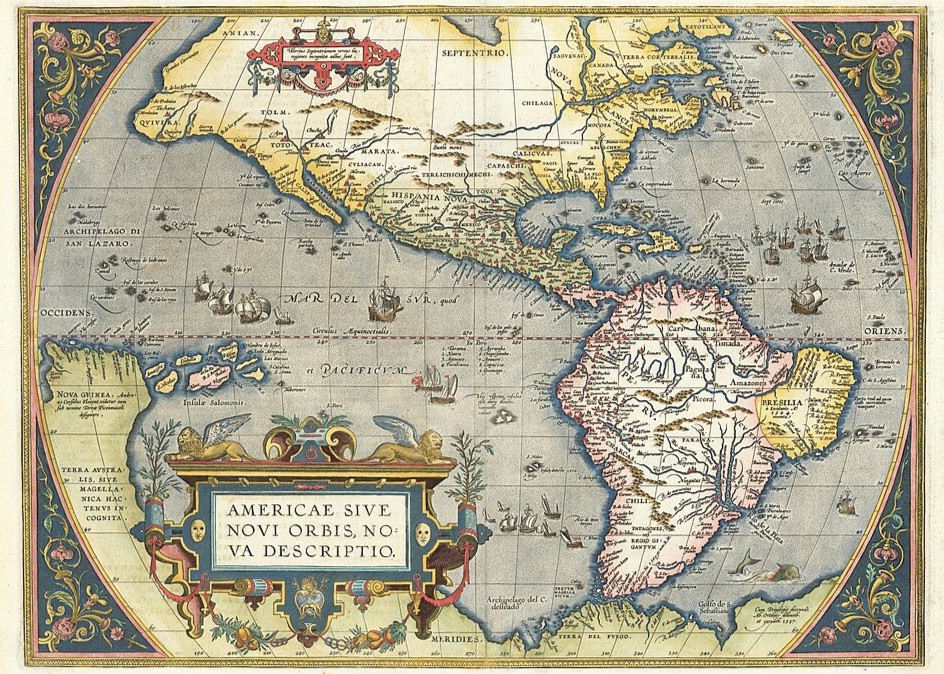
In the middle decades of the 19th century, writers and intellectuals in several of the independent republics which had emerged from the collapse of the Spanish Empire in America, with a shared history and a common language and culture, began to refer to Spanish America (previously “América Española” or “Hispanoamérica”) as “América latina”. With the notable exception of Carlos Calvo, Argentine historian and international lawyer, none of them considered the independent Empire of Brazil to be part of “América latina”. Brazilian writers and intellectuals at the time were equally conscious that Brazil was separated from the Spanish American republics by geography, by history (Portugal’s long struggle to maintain its independence from Spain, the different colonial experiences of Portuguese America and Spanish America, and their different paths to independence), by social structure (Brazilian society was based on African slavery), by political institutions (Brazil alone was not a republic), and, above all, by language and culture. They, too, did not regard Brazil as part of “América latina”. And relations between the Empire of Brazil and the republics in what Brazilian diplomats referred to as “América Espanhola”, “América Meridional” or simply “América do Sul” were extremely limited, except in the Rio de la Plata, where three wars were fought: 1825-1828, 1851-1852 and the Paraguayan War between 1864 and 1870.
In the final decades of the 19th century and early decades of the 20th century, Spanish American writers, intellectuals, and now politicians and diplomats, increasingly used the expression “America latina”–as well as, for example, “Indoamérica” (Victor Raúl Haya de la Torre), “América Indo-Ibérica” (José Carlos Mariátegui), “Nuestra América” (José Martí)–primarily to differentiate “América Española”/“Hispanoamérica” from the “other America”, the United States of America, Anglo-Saxon America. Again, with a few exceptions (for example, Manuel Baldomero Ugarte in Argentina, José Vasconcellos and Alfonso Reyes in Mexico), they excluded Brazil from their concept of “América latina”, and indeed showed little interest in Brazil. With some notable exceptions (Manuel de Oliveira Lima, José Veríssimo and Sílvio Júlio de Albuquerque Lima, Brazil’s only genuine Hispanist), Brazilian writers and intellectuals continued to see Brazil, which abolished slavery in 1888 and declared itself a republic in 1889, separated from the Spanish American republics by unbridgeable historical, linguistic and cultural differences, showed no great interest in Spanish America, and failed to identify with the concept of “America latina”. With the exception of Argentina and, to a lesser extent, Chile, and in the resolution of a number of frontier disputes, the Brazilian governments of the First Republic showed no greater interest in Spanish America than the governments of the Empire, while relations with the United States became increasingly close.[1]
At independence in 1776, the 13 English colonies in North America had adopted the name United States of America, and the United States more than doubled its size with the Louisiana Purchase from France in 1803 and the absorption of Florida by treaty with Spain in 1819. The revolutions throughout the Spanish Empire in America at the beginning of the 19th century, which resulted in the establishment of a number of independent republics, led Thomas Jefferson and others to elaborate the idea of an “American system” based on a special relationship between the peoples and governments of the Americas, North and South, a shared American geography and history, shared American ideas of republicanism, liberty and democracy (sic). Jefferson himself included Brazil, not independent from Portugal until 1822 and not to be a republic until 1889, in his “American system”. In December 1823, in the section of his Annual State of the Union Address to Congress, which became known as the Monroe Doctrine, US President James Monroe declared that the United States would oppose any future European colonization and political intervention by any European power in the “American continents”, the “Western Hemisphere”, North and South America. It was a purely rhetorical declaration. Monroe was well aware of the limits of US power at the time. And during the following sixty years no US president gave much attention to the Western Hemisphere. The focus was on the Manifest Destiny of the United States to expand its territory across the continent of North America to the Pacific, largely at the expense of Mexico.
From the late 19th century, however, US governments returned to the idea of Pan Americanism. In 1889 the United States invited the “nations of the Western Hemisphere”, including the Empire of Brazil (which was about to declare itself a republic), to an International Conference of American States to be held in Washington, DC, with the aim of creating a kind of informal alliance. At the same time, with the West largely settled, the domestic economy booming, and growing concern over the threat potentially posed by “new imperialism” in Europe, the United States was beginning to assert US economic and political hegemony in the region south of the Rio Grande (Mexico, Central America and South America), which they increasingly referred to as “Latin America”, from the Spanish “América latina”, but including Brazil. Scholars in leading US universities who studied its history, geography, literature and culture, and later its politics, economy and society, initially tended to refer to the region as “Hispanic America”, sometimes but not always including Brazil. After the First World War, they also gradually came to call the region, including Brazil, “Latin America”.[2] This essay examines the evolution of the concept “Latin America”, to encompass both Spanish America and Brazil, from the late 19th century to the Second World War.
***
The earliest use of the term “Latin America” by the US government would seem to have been in Reciprocity Treaties with Latin America, a document presented to Congress in June 1890, with a message from President Benjamin Harrison and a letter from Secretary of State James G. Blaine.[3] It advocated the negotiation of reciprocal tariff agreements reducing trade barriers between the United States and the “Latin American nations”. This had been a principal recommendation of the International Conference of American States held in Washington, DC (October 1889-April 1890). The first reciprocal trade agreement was signed with Brazil in 1891 (reinforced by a treaty in 1904).
In his instructions to the US delegates to the second International Conference of American States held in Mexico City (October 1901-January 1902), President Theodore Roosevelt expressed the desire of the United States to be “the friend of all the Latin American republics and the enemy of none” (United States 1901).[4] However, in his fourth Annual Address to Congress on December 6, 1904, in a passage that became known as the Roosevelt Corollary to the Monroe Doctrine, Roosevelt famously threatened US intervention in “America” (that is, Latin America) in cases of “chronic wrongdoing, or an impotence which results in a general loosening of the ties of civilized society” (National Archives 1904).
In 1909, President William Howard Taft’s Secretary of State Philander C. Knox charged Assistant Secretary of State Francis M. Huntington Wilson with the task of enlarging and reorganizing the Department. Five new divisions, all but one geographic, were created (and approved by Congress in June 1910): Latin America, Far East, Near East, Western Europe and Information. The “Division of Latin American Affairs”, responsible for diplomatic and consular correspondence to and from Latin America, in practice dealt only with Mexico, the Caribbean and Central America; it showed no great interest in South America (Huntington-Wilson 1945; Scholes & Scholes 1970; Hunt 1914, 241-247).[5]
During the First World War, in September 1917, President Woodrow Wilson established what became known as The Inquiry, an autonomous “think tank” on US foreign policy led by Colonel Edward H. House and funded first by the Treasury and then by the State Department. It was entrusted with the task of preparing materials for the peace settlement at the end of the war and, more generally, US policy in the post-war world. By October 1918, it had 126 members, drawn mainly from five institutions: Harvard, Yale, Columbia, Princeton and the American Geographical Society in whose building in New York it met (in secret). There were six areas of study: government and politics, geography, the social sciences, history, economics and business, and international law, and several regional divisions. From May 1918, 12 of the 57 members of The Inquiry assigned to regional divisions, mostly from Yale, found themselves attached to the “Latin American Division”, which included Brazil. By August, Latin America was absorbing a disproportionately high portion of the Inquiry’s budget, far more than was allocated, for example, to Europe, Asia or Africa. In fact the Latin American Division was receiving more money than all the other regional divisions combined (Gelfand 1963, 100-102, 274-289).[6]
Outside official circles, however, the expression “Latin America”, to embrace both Spanish America and Brazil, was not widely used before the First World War. William Eleroy Curtis, Chicago journalist and author, chief organizer of the first Inter-American Conference in Washington, DC in 1889-90 and first director of the International Bureau of American Republics (later Pan American Union), had, in 1888, published the 750-page volume The Capitals of Spanish America, which included a 100-page chapter on Rio de Janeiro. “Hispanic America” was the term more commonly used than “Latin America”. The Hispanic Society of America was founded in New York in 1904 “to advance the study of the Spanish and Portuguese languages, literature and history (...) and the study of the countries wherein Spanish or Portuguese are or have been spoken” (Delpar 2007, 30, my italics). The research of João Feres Jr. revealed that neither the Library of Congress nor the New York Public Library has a single book, journal or periodical in English published before 1900 with “Latin America” in its title, and only two (in the Library of Congress) published between 1900 and 1910 (Feres Jr. 2023, 81 and 287).[7]
In 1911, the Boston quarterly periodical The Living Age, published since 1844, included two long articles on “The Promise of Latin America”, that is to say “the 16 republics which make up what is known as Latin America”, 15 of them “thoroughly Spanish”, together with Brazil, and in particular “the leading Latin American States: Mexico, Argentina, Chile and Brazil” (Living Age 1911a, 346-55; 1911b, 396-407). The several books on “Latin America” listed as having been published “during the past five or six years”, however, relate either to individual Spanish American republics (Mexico, Argentina, Chile, Colombia) or to South America alone, and were written by British as well as US authors. The first general introduction in English to the history, governments, economies, societies and cultures of the region called Latin America by a US author was published as late as 1914: Latin America by William R. Shepherd, a professor of History at Columbia University. The Preface opens as follows: “‘Latin America’ is a geographic expression applied to the twenty republics in the New World. Eighteen of them have arisen from Spanish origins, and hence are known collectively as ‘Spanish America’. Of the other two, Brazil has sprung from Portuguese settlement, and Haiti owes its existence to France”.
***
During the period from the 1890s to the First World War, in parallel with the rise of the United States as a regional power, historians of the United States in US universities were drawn, in both their research and their teaching, first to the history of the Borderlands (those parts of the United States formerly Spanish/Mexican), then to the history of Spanish America, especially colonial Spanish America, and finally to the history of Hispanic America as a whole, sometimes but not always including Brazil. Beginning in 1894-1895, Bernard Moses (1846-1930), professor of history and political science at the University of California, Berkeley–from 1875 until he retired in 1911–was the first to offer a graduate level course on Hispanic American history in a US university, but it was a course on Spanish American History and Institutions. In an article published in 1898, however, Moses encouraged the study of what he called “the neglected half of American history”, by which he meant the history of Spanish, Portuguese and French America (Moses 1898).[8]
At the University of Texas from 1901, at Stanford from 1909, and then at the University of California, Berkeley, after he moved there in 1911 replacing Bernard Moses, Herbert E. Bolton (1870-1953) taught what he called in his famous presidential address to the American Historical Association in 1932 “The Epic of Greater America”, that is, “the common history of the Americas from the North Pole to the South Pole and from Columbus to the present” (Bolton 1933, reprinted in Cline 1967; on Bolton, see Bannon 1978; Magnaghi 1998). Many of his graduate students went on to become professors of Latin American history in leading US universities. Other “precursors” in the teaching of Latin American history in US universities were Edward G. Bourne (1860-1908) at Yale, William R. Shepherd (1871-1934) at Columbia, William Spence Robertson (1872-1955) at the University of Illinois, Urbana, and Percy Alvin Martin (1879-1942) at Stanford. In an address at the annual meeting of the American Historical Association in 1909, echoing Moses a decade earlier, Shepherd argued that “American history does not consist solely of the history of the United States”. It must include “the rest of the Americas–Spanish, Portuguese and French, the entire Western Hemisphere” (Shepherd 1911; reprinted in Cline 1967). He published Latin America in 1914 (as previously mentioned) and The Hispanic Nations of the New World: Our Southern Neighbours (including Brazil) in 1919. Martin, who had been trained as a medievalist in European universities and at Harvard and whose first course at Stanford was on the history of Spain and Spanish America, was the only one who considered himself something of a “Brazilianist”. He was the translator into English of the six lectures given by the Brazilian diplomat and historian Manuel de Oliveira Lima at Stanford in October 1912, published as The Evolution of Brazil Compared with that of Spanish and Anglo-Saxon America (1914). In 1925 he published Latin America and the War, based on the lectures he gave at Stanford during the First World War.
By 1914, a group of “Hispanist” historians had been formed within the American Historical Association (AHA). It was, however, relatively marginal, allowed few sessions at the annual meetings of the AHA, and had only limited access to the AHA’s prestigious journal the American Historical Review. Two of its members, William Spence Robertson and Charles E. Chapman, a young assistant professor at Berkeley (and student of Bolton), attended the Congreso Americano de Bibliografia y Historia in Buenos Aires in July 1916, to mark the centenary of Argentine Independence. Many of the 200 historians there from across Latin America support the idea of a journal in English devoted to the history of Spanish and Portuguese America. At the annual meeting of the AHA in Cincinnati on December 30, members of the Hispanic American Historians Group took the decision to establish the first academic journal devoted to the history of “the southern countries of the Americas”. The initiative had the support of the Pan American Union and the State Department. Robert Lansing, president Woodrow Wilson’s Secretary of State, wrote that the journal “would be of great benefit, both to the scholars of this country and those of Latin America” (Berger 1995, 32).
There followed an interesting debate on what name to give the journal. Chapman and Robertson had proposed Ibero-American Historical Review. This did not find general acceptance. Latin American Historical Review was proposed, but also found unacceptable. Latin, it was argued, pertained to France and Italy as well as Spain and Portugal and was, therefore, in the words of Juan C. Cebrián, the journal’s Spanish-born chief financial backer, “ambiguous, misleading and unscientific”. Moreover, for many members of the group, like their Spanish American contemporaries, Latin America still signified Spanish America only (Chapman 1918; reprinted in Cline 1967; Feres Jr. 2004, 82-4; Delpar 2007, 50). It was finally decided to call the journal the Hispanic American Historical Review (HAHR). Hispania (from the Roman), it was argued, referred to the whole peninsula, and therefore to both Spain and Portugal and by extension to both Spanish America and Brazil. The HAHR was launched in January 1918. Publication was suspended in November 1922 for financial reasons, but in 1926 Duke University Press agreed to publish the Review (and has published it continuously since then). Apart from occasional articles in the American Political Science Review, the HAHR was virtually the only journal to publish articles in English on “Hispanic America”, including Brazil, before the Second World War. It was 1940, however, before the first article with “Latin America” in the title was published: Some Cultural Assets of Latin America by Herbert Eugene Bolton (1940).
The first college text books on the history of Latin America, including Brazil, were published immediately after the First World War: William Warren Street (DePauw University), A History of Latin America (1919), and William Spence Robertson, The History of the Latin American Nations (1922). The first high school text was Hutton Webster (University of Nebraska), A History of Latin America (1924) (Conn 1934; reprinted in Cline 1967). In the early thirties, two more college texts were published (interestingly, still using the term Hispanic America rather than Latin America, but including Brazil): A. Curtis Wilgus, A History of Hispanic America (1931), and J. Fred Rippy Historical Evolution of Hispanic America (1932). J. Fred Rippy (1892-1977), at the University of Chicago, had edited and written the introduction to Destiny of a Continent (1925), by the Argentine Manuel Baldomero Ugarte (1875-1951), who was perhaps the first prominent Spanish American intellectual to make the case that Brazil was an integral part of “América latina”, in, for example, El porvenir de América latina (1910), which nevertheless appeared in some editions as El porvenir de América Española.
In 1923, Clarence H. Haring (1885-1960), one of the founders of the HAHR, was appointed to an endowed chair, the first of its kind, a professorship of Latin American History and Economics at Harvard, funded by and named after philanthropist and former ambassador to Argentina Robert Woods Bliss. During the Depression, Haring organized a series of influential Summer Round Tables on Latin America at the University of Virginia’s Institute of Public Affairs, which attracted prominent figures in the US administration, diplomats, directors of US companies, editors of newspapers and magazines, lawyers and university professors. Haring was also Associate Director of the Harvard Bureau for Economic Research on Latin America, which published The Economic Literature on Latin America: A Tentative Bibliography in 1936. Towards the end of a long and distinguished career at Harvard, Haring published a monograph on Brazil, Empire in Brazil: A New World Experiment with Monarchy (1958) (Salvatore 2016a).
At the annual meeting of the American Historical Association in Washington, DC in December 1927, the Hispanic American History Group rejected a proposal to form an independent Academy of Hispanic American History. In Indianapolis, the following year, a Conference on Hispanic American History, an informal, autonomous professional organization of Hispanic American historians affiliated to the AHA, was established. At the AHA annual meeting in Chicago, in December 1938, the Conference, by four votes to one, voted to change its name to the Conference on Latin American History (CLAH) (Cleven & Wilgus 1928; Cleven 1929; Fisher 1939; all reprinted in Cline 1967). Charles Edward Chapman, who voted against, had declared his continued preference for Hispanic America over “the incorrect term Latin America” in his recently published Colonial Hispanic America: A History (1933), which included colonial Brazil. Although both the terms Hispanic American and Latin American for most US historians embraced Brazil, the Conference continued to be dominated by historians of Spanish America. In an article published in the HAHR in 1933, William Shepherd made the case for a more extensive study of Brazilian history, pointing out that there did not even exist a complete general history of Brazil in any language, English, French, German, or even Portuguese. “Of all the nations of the New World”, he argued, “the United States of Brazil stands alone as a country of great international importance which lacks a comprehensive and altogether adequate treatise on its past” (Shepherd 1933; reprinted in Cline 1967).
***
The principal pioneer of Hispanic American/Latin American literature as a specialized academic field of teaching and research in the United States, in the period before and immediately after the First World War, was Jeremiah Ford (1873-1958), from 1911 professor of Romance Languages at Harvard (Degiovanni 2018, chapter 1). Ford saw himself as the latest in a long line of US Hispanists, specialists on the history, literature and culture of Spain–William Hickling Prescott, George Ticknor, Henry Wadsworth Longfellow, Mary Tyler Peabody Mann, Hubert Howe Bancroft–, but he recognized the limitations of Hispanismo. It needed to focus more on the language and literature of contemporary Spanish America. In 1929, he established a Council on Hispanic-American Studies at Harvard–the first of its kind. At the same time, he believed that Hispanismo should also embrace the language and literature of Brazil. He provided the Introduction to Brazilian Literature (1922), a 300-page groundbreaking study by a former student Isaac Goldberg (1887-1938) (Garcia 1972). “Very many of the literary achievements of colonial, imperial and republican Brazil”, Ford wrote, “are unquestionably of lasting worth”. Federico de Onís (1885-1966), on the other hand, a Spanish scholar primarily interested in Spain and Spanish America, who taught at Columbia from 1916, adamantly rejected the inclusion of Brazilian literature within the field of “Hispanic literatures”. “There is no synchronism between Brazilian and Portuguese literature”, he wrote, “nor between Brazil’s and Spanish America’s, despite the community fostered by the continent’s conditions”. Any attempt to bring them together was, for Onís, a “cosa impusta (forced endeavour)” (Degiovanni 2018, chapter 3).
Alfred Coester (1874-1958) was, like Isaac Goldberg, one of Jeremiah Ford’s “boys”. He had published in 1916 A Literary History of Spanish America, again the first of its kind in English, perhaps in any language. After serving as a Latin American expert on the so-called Inquiry at the end of the First World War, Coester became assistant professor of Spanish at Stanford in 1920. He was at the same time, from 1917 to 1926, Secretary-Treasurer of the American Association of Teachers of Spanish (AATS). In 1927, in an article on “Practical Pan Americanism” in the journal Hispania, Coester argued that it had been wrong to promote the teaching of Latin American history rather than Latin American literature in US universities. “The Latin American soul”, he wrote, “is to be found in Latin American literature”. When, in June 1927, Leo Stanton Rowe, director-general of the Pan American Union, read the article, he sent Coester a private memorandum asking his views on the feasibility of establishing chairs in Latin American literature in US universities to strengthen hemispheric cooperation in advance of the sixth Pan American conference to be held in Havana in 1928. Coester suggested to his own university that it should take the initiative and, in December 1927, Stanford made Coester full professor. It was the first chair of Latin American literature in the United States, but held by a specialist on Spanish and Spanish American literature only (Degiovanni 2018, chapter 2).
Hispania, an academic journal devoted to the language and literature of Hispanic America, had been launched in 1918, the same year as the Hispanic American Historical Review. There had been a debate on what name to give the journal, similar to that over the establishment of the HAHR. In the first issue, its founding editor-in-chief, Aureliano M. Espinosa (1889-1958), professor in the Department of Romance Languages at Stanford, denounced the increasing use of the term “Latin America” to refer to the region South of the United States as “improper, unjust, unscientific”. The only appropriate names were Spanish America or Hispanic America, because the region’s language and culture originate in Spain, not France, Italy–or Romania! (Portugal was not even considered) (Espinosa 1928; Delpar 2007, 29). Unlike the HAHR, Hispania was from outset devoted to the language and literature of Spanish America only. Its principal aim, as Espinosa put it, was “the betterment of the teaching of Spanish in our schools and colleges”, not least in the interest of US economic and political relations with Latin America. Alfred Coester was editor-in-chief of Hispania from 1926 to 1941. Only after 1942, under editorship of Henry Gratton Doyle (1889-1964) of George Washington University, were articles on Luso-Brazilian language and literature included. The Hispanic Review, on the other hand, established in the Department of Romance Languages at the University of Pennsylvania in 1933 and published quarterly by the University of Pennsylvania Press, was devoted from the beginning to both Hispanic and Luso-Brazilian literature and culture. In 1944 the AATS became the American Association of Teachers in Spanish and Portuguese.
***
Leo Stanton Rowe (1871-1946), President of the American Academy of Political and Social Science from 1902 to 1930, one of the first “experts” on Latin America to be hired by the US Treasury (1917-1919) and by the State Department (he was head of the Department’s Division of Latin American Affairs, November 1919-September 1920), and from 1920 until 1946 Director General of the Pan American Union, was an early pioneer in the teaching of Latin American politics and the international relations of Latin America. As professor of Political Science at the University of Pennsylvania from 1894 to 1917, Rowe had offered a course on the Governments and Constitutions of Latin America as early as 1907-1908, and a course on the United States and Latin America in 1916-1917 (Salvatore 2016b).
Isaiah Bowman (1878-1950), Director of the American Geographical Society (founded in 1851) from 1915 to 1935, was a pioneer in the study of the geography of Latin America. He had led three expeditions to South America in 1907, 1911 and 1913, and was the author of South America: A Geography Reader (1915). He was prominent among the academic experts attached to the Latin American Division of The Inquiry at the end of the First World War. And for more than twenty years (1922-1945), he led the team at the American Geographical Society that produced the Millionth Map of Hispanic America, the definitive mapping of the subcontinent below the US-Mexico border on the scale 1:1,000,000, which has been described as the largest research project in the United States between the wars (Smith 2003; Salvatore 2016c). Other pioneers were Carl O. Sauer (1889-1975), the founder of the Berkeley School of Latin American Geography (King 1980), and Preston E. James (1889-1986), the author of Latin America (1942, and numerous subsequent editions), the most widely used text book on the human geography of Latin America (Martin 1988; Robinson 1980).
During the 1920s and 1930s, Latin America (always including Brazil) gradually became a subject of study across the social sciences. By 1940, almost every US university of any consequence offered courses on the economics, government, politics and international relations of Latin America. This is reflected in the books that were published: for example, The Republics of Latin America: Their History, Governments and Economic Conditions (1923), by Herman G. James and Percy A. Martin, which included a substantial chapter on Brazil; Fred Rippy’s Latin America in World Politics (1928); The People and Politics of Latin America (1930), by Mary Wilhelmine Williams; Whither Latin America? An Introduction to Its Economic and Social Problems (1934), by Frank Tannenbaum, probably the most widely read book on Latin America at the time. However, the rural sociologist and demographer Thomas Lynn Smith (1903-1976), who specialized in Brazil, insisted that prior to 1935 “anything dealing with Latin America on the part of a sociologist in the United States was conspicuous by its absence” (Delpar 2007, 88).[9]
***
In 1931, the American Council of Learned Societies (ACLS)–a private nonprofit organization founded in 1919, representing 13 learned societies, including the American Economics Association (1885), the American Political Science Association (1903) and the American Sociological Society (later Association) (1905)–had established an advisory Joint Committee on Latin American Studies under the chairmanship of the Harvard historian Clarence Haring. In April 1935, at a meeting of the Committee held at the New York offices of the Social Science Research Council (founded in 1923), 15 participants from nine universities, the Library of Congress and the American Geographical Society, representing anthropology, economics, geography, government, history and literature, agreed to support a multidisciplinary bibliographical project on Latin America. It would be an annual annotated guide to books and articles on Latin America, both Spanish America and Brazil, in both the humanities and the social sciences. Lewis Hanke, a young, 30 year-old historian of colonial Spanish America, completing a PhD at Harvard under Haring, was appointed editor of the Handbook of Latin American Studies (HLAS), to be published by Harvard University Press. The first volume appeared in 1936 (publications of the year 1935). The Handbook had separate sections on Brazilian art, literature, history, etc. Volume 3 (1938) was dedicated to the centenary of the Instituto Histórico e Geográfico Brasileiro (IHGB) and included a guide to Brazil’s principal cultural institutions.
In 1940, 20 US universities had Latin American Studies programmes incorporating disciplines in both the humanities and the social sciences, although half of all the courses offered were in history (Leonard 1943; reprinted in Cline 1967). At the same time, impressive multi-disciplinary library collections on Latin America, including Brazil, were being built by several universities, notably Harvard, Yale, Texas, Wisconsin, Michigan, Duke, Tulane and Chicago, as well by the Library of Congress. In 1939, Lewis Hanke became the head of a new division of the Library of Congress devoted to Portugal, Spain and Latin America. It was named the Hispanic Foundation (now Hispanic Division). In 1940, the 28 year-old historian of Portuguese and colonial Brazilian art and architecture Robert C. Smith, who had just completed his PhD at Harvard, became assistant director, reflecting the Library’s determination that Brazil would not be neglected. The Brazilian artist Portinari was commissioned to paint a mural for the vestibule of the Reading Room (it was completed in 1942). It depicted in four panels the arrival of the Spanish and the Portuguese in the New World.
Hispanic American/Latin American studies in US universities were still overwhelmingly studies of Spanish America, primarily Mexico and Central America. Most “Latinamericanists” did not speak or read Portuguese, knew little of Brazilian history and culture, and indeed rarely, if ever, visited Brazil. There was, however, a growing interest in Brazil, not least because Brazil was by far the most important Latin American ally of the United States during the Second World War. In a study of the development of Latin American studies in the United States (1939-1945), Lewis Hanke wrote that during the war there was finally a recognition that special efforts were needed to develop the study and teaching of Brazilian history and culture: “for the first time [Brazil] has come to be recognized in the United States as an important area worthy of special consideration. Too often in the past our Latin American Studies have meant Spanish American studies, with Brazil ignored or neglected” (Hanke 1947; reprinted in Cline 1967). All Latin American studies programmes had provision for historians and social scientists to learn Brazilian Portuguese as well as Spanish, although Jorge Basadre, the Peruvian historian and former Director of the National Library of Peru, who at the end of the Second World War was invited by the Pan American Union to produce a survey of Latin American studies in the United States, admitted “the battle for Portuguese has not yet been won” (Basadre 1949; reprinted in Cline 1967).
***
The sixth International Conference of American States, held in Havana in January 1928, demonstrated the alarmingly poor state of US relations with Latin America after more than twenty years of US interventionism under the Roosevelt Corollary to the Monroe Doctrine, mainly in Central America and the Caribbean (Brazil alone generally maintained good relations with the United States). In December, President-elect Herbert Hoover made a ten-week goodwill visit to ten Latin American countries in which he pledged that the United States would in future act as a “good neighbor” and, in particular, abstain from armed intervention in the region. In the 1930s, faced with an external threat to US economic and geo-political interests in Latin America from the emerging fascist powers of Europe, the administration of Franklin D. Roosevelt responded by reaffirming a Good Neighbor Policy towards Latin America and emphasizing the importance of Inter-American solidarity. One of the most widely read books at this time was The Coming Struggle for Latin America (1938), by the radical political journalist Carleton Beals (1893-1979) (on Beals, see Britton 1987). In a series of meetings of American Foreign Ministers–Panama (September 1939), Havana (July 1940) and Rio de Janeiro (January 1942)–the United States succeeded in securing the support of Latin America (all the States except Argentina) in a united front against the Axis powers (Germany, Japan and Italy).
The Second World War marked the high point of hemispheric solidarity and Inter-American cooperation. And closer relations between the United States and Latin America–especially Brazil–during the war were not only political, military and economic, but also cultural. From July 1938 until 1942, the State Department’s Division of Cultural Relations focused almost exclusively on Latin America (Delpar 2007, 112). From August 1940 and throughout the war, the Office for the Coordination of Commerce and Cultural Relations between the American Republics (renamed in 1941 the Office of the Coordinator of Inter-American Affairs), under the direction of Nelson Rockefeller, formulated and executed a programme aimed at winning hearts and minds in Latin America, and promoted the spread of knowledge of Latin America in the United States through the Institutes and programmes of Latin American studies in US universities. From March 1942, a Joint Council of the American Council of Learned Societies, the Social Science Research Council, the National Research Council, and (from 1944) the Rockefeller Foundation and the Carnegie Endowment for International Peace supported research (in the humanities and social sciences but also in medicine, public health, etc) and intellectual cooperation between the United States and Latin America (Delpar 2007, 117).
Many more books on Latin America were now published–over 150 in the 1940s, during and immediately after the Second World War, compared with a total of less than 100 in the entire period before 1940.[10] And Brazil was treated as an integral part of Latin America in all the books that dealt with the region as a whole–for example, among the most widely read, John Gunther, Inside Latin America (1941); Samuel Flagg Bemis, The Latin American Policy of the United States: an historical interpretation (1943); Harriet M. Brown and Helen B. Miller, Our Latin America Neighbors (1944), a high school text book; John A. Crow, The Epic of Latin America (1946); Austin F. Macdonald, Latin American Politics and Government (1949), the first politics textbook; and Wendell C. Gordon, The Economy of Latin America (1950), the first economics textbook.
***
The emergence of the United States as a global power during the Second World War led to a demand for more expertise in military and political strategic planning for the post war period. A so-called Ethno-geographic Board was created (1942-1944), bringing together specialists from the National Research Council, the American Council of Learned Societies, the Social Science Research Council and the Smithsonian Institution, to gather data for the war effort and to provide a structure around which to organize policy and through which to develop education and research (Bennett 1947; Lewis & Wigen 1997, 163). The Board began by dividing up the world into continents–with one important exception: instead of the Western Hemisphere or the Americas or North and South America, there were to be two components–the United States and Latin America. When the Board later decided to divide the world into regions with a degree of geographic, geopolitical and cultural homogeneity, Latin America presented itself as one of the most cohesive of regions in terms of religion, language and culture, history, and economic, social and political structures. The differences between Spanish America and Brazil–in all these respects (except to some extent religion), not least language, and the huge disparities in size and population between Brazil and all the other countries in the region, that is to say, the singularities of Brazil–were simply ignored.
In the planning of the conference held at Bretton Woods, New Hampshire in July 1944 to discuss the post-war international economy, Harry Dexter White, the chief US negotiator, emphasized to President Roosevelt the important role to be played by “our neighbours in Latin America” (although he also referred to them all as “the South Americans”) (Helleiner 2014). Latin America was given two of the 12 executive directors of the International Monetary Fund (IMF) and one seat on the Executive Board of the International Bank for Reconstruction and Development (the World Bank). Latin America was not represented at the Dumbarton Oaks Conference in Washington, DC, August-October 1944, where post-war international peace and security were discussed and the foundations laid for the United Nations. In compensation, an Inter-American Conference on the Problems of War and Peace was held at Chapultepec in Mexico City, December 1944-March 1945, where the US Secretary of State, Edward Stettinius, offered assurances that the United States had not neglected Latin America, and would ensure that there was “adequate representation” for Latin America in any new post-war international organization (Smith 1994, chapter 3). In view of its size and importance, what it had come to regard as a special relationship with the United States developed during the various Inter-American Conferences, and the degree of support it had given the United States during the War, Brazil was disappointed to find that at all these conferences–Bretton Woods, Dumbarton Oaks, Chapultepec–it was treated by the United States as simply one of the twenty republics that constituted Latin America. At the Conference on International Organization in San Francisco, April-June 1945, there was some discussion within the US delegation about a permanent seat, a sixth seat, for Brazil on the Security Council of the United Nations, but in the end the issue met with resistance and was not pursued. All the Latin American States, including Argentina, signed the UN Charter.
EPILOGUE
By the end of the Second World War, the view that the twenty republics south of the Rio Grande, including Brazil, constituted “Latin America” was firmly established in official US thinking, in US universities, think tanks and foundations, in the US media and in corporate America. And because of the global power and influence of the United States in the post-war period, the US idea of “Latin America” was generally adopted by multilateral institutions (for example, the United Nations Economic Commission for Latin America, ECLA/CEPAL, established in Santiago de Chile in 1948), and by governments, NGOs, foundations, learned societies and universities throughout the world. It was, however, by no means universally adopted in Spanish America, and least of all in Brazil.
Brazilian intellectuals, writers, artists and academics became more aware of, and more appreciative of, Spanish American literature and culture than in the past. And in the period from the 1960s to the 1980s some leading Brazilian intellectuals, for example, Celso Furtado, Darcy Ribeiro and Fernando Henrique Cardoso, but also surprisingly Gilberto Freyre, well known for his writings on Luso-Brazilian exceptionalism, were to some extent “latinamericanized”, that is to say, began to self-identify as Latin American (Bethell 2018 49-51; 2024 76-78). But these were exceptions. The majority of Brazilians continued to think of Latin America as synonymous with Spanish America. Brazilians did not consider themselves to be latino-americanos, just as Brazilians living in the United States were not latinos.
As for Brazilian governments, they joined the Latin American Free Trade Area (ALALC) in 1960 and the Association for Latin American Integration (ALADI) in 1980, were represented at the anual meetings of the Rio Group of Latin American and Caribbean States from 1986, and supported the founding of the Community of Latin American and Caribbean States (CELAC) in 2010. But Latin America was never a major concern in Brazilian foreign policy. And, with the exception perhaps of Argentina and the other members of Mercosul (1991), initially Uruguay and Paraguay, Brazil´s political and economic relations with the individual Spanish American republics were scarcely more significant than they had been in the past. Relations with a country as important in Latin America as Mexico were for the most part merely diplomatic. After the creation of the North American Free Trade Area (NAFTA) in 1994, the United States, Canada and Mexico, Brazilian governments identified more with South America than Latin America. Brazil hosted the first meeting of South American presidents in Brasília in 2000. And in Brasília in 2008 they agreed to form a Union of South American Nations (UNASUL/UNASUR). Priority, however, continued to be given not to economic and political integration in Latin America, or even South America, but to Brazil´s bilateral relations with the United States, the European Union (and the UK) and countries in the wider world, not least today China.
Notes
[1]See “Brazil and Latin America” (Bethell 2018, 19-22, 34-43); revised and expanded, in Por que o Brasil? Ensaios de história e política (2024, 41-45, 59-69). On the evolution of the concept “América Latina” in Spanish America, generally excluding Brazil, from the middle of the 19th century onward, see the classic Arturo Ardao (1980), Génesis de la idea y el nombre de América latina, and more recently, for example, Mauricio Tenorio-Trillo (2017, chapters 1-3), Latin America. The Allure and Power of an Idea, and Carlos Altamirano (2021, chapter 2), La Invención de Nuestra América: Obsesiones, Narrativas y Debates sobre la Identidad de América Latina.
[2]In this period, the French, who in the middle of the 19th century had been among the first to refer to Spanish America as “L'Amérique latine”, also adopted the expression to include Brazil: for example, the journals Bulletin de l'Amérique latine (1911-21), Revue de l'Amérique latine (1922-32) and L'Amérique latine (1923-c.1945), André Siegfried, Amérique latine (1934), and Victor Tapié, Histoire de Amérique latine au XIXe siècle (1945). The English generally preferred the expression “South America” to “Latin America” at this time–even when including Mexico and Central America. See, for example, Lord Bryce, South America: Observations and Impressions (1912) and the South American Handbook, published annually from 1924.
[3]Oxford English Dictionary (2nd edition, 20 volumes, 1989); João Feres Jr. (2004, 51-55).
[4]Foreign Relations of the United States. The International Conferences of American States (1906 vol. II, Pt 2), document 594, 8 October 1901.
[5]The Board of Foreign and Domestic Commerce of the US Department of Commerce, established in 1912, also had a Latin American Division.
[6]The Inquiry was officially wound up on January 31, 1919.
[7]Apart from chapter 2 “Latin America na linguagem cotidiana”, pp. 51-76, the Feres Jr. volume focuses on the period after 1945.
[8]Several of the primary sources on which this article is based are reprinted in Howard F. Cline (1967), Latin American History. Essays on Its Study and Teaching 1898-1965.
[9]A section on Sociology was added to the Handbook of Latin American Studies only in 1951.
[10]João Feres Jr. Found, from his research in the Library of Congress, two books with Latin America in the title published before 1910 (see footnote 7), 23 between 1911 and 1920, 25 in the 1920s and 50 in the 1930s, 155 in the 1940s.
References
Altamirano, Carlos. 2023. La invención de Nuestra América: Obsesiones, narrativas y debates sobre la identidad de América Latina. Buenos Aires: Siglo XXI Editores.
Ardao, Arturo. 1980. Génesis de la idea y el nombre de América Latina. Centro de Estudios Latinoamericanos Rómulo Gallegos.
Bannon, John F. 1978. Herbert Eugene Bolton: The Historian and the Man, 1870-1953. Tucson: University of Arizona Press.
Basadre, Jorge. 1949. “Latin American Courses in the United States.” In Courses on Latin America in Institutions of Higher Education in the United States, 1948–1949, compiled by Estellita Hart. Washington, DC: Division of Education, Department of Cultural Affairs, Pan American Union.
Bennett, Wendell Clark. 1947. The Ethnogeographic Board, Volume 107. Washington, DC: The Smithsonian Institution.
Bethell, Leslie. 2018. “Brazil and Latin America.” In Brazil: Essays on History and Politics, Leslie Bethell. Institute of Latin American Studies, School of Advanced Study & University of London.
Bethell, Leslie. 2024. Por que o Brasil? Ensaios de história e política (Volume 1). Rio de Janeiro: Editora Topbooks.
Berger, Mark T. 1995. Under Northern Eyes: Latin American Studies and U S Hegemony in the Americas 1898-1990. Bloomington: Indiana University Press.
Bolton, Herbert E. 1933. “The Epic of Greater America.” The American Historical Review 38 (3): 448-474. https://doi.org/10.1086/ahr/38.3.448.
Bolton, Herbert E. 1940. “Some Cultural Assets of Latin America.” The Hispanic American Historical Review 20, no. 1 (February): 3-11. https://doi.org/10.2307/2507476.
Britton, John A. 1987. Carleton Beals: A Radical Journalist in Latin America. Albuquerque: University of New Mexico Press.
Chapman, Charles E. 1918. “The Founding of the Review.” Hispanic American Historical Review 1 (1): 8-23. https://doi.org/10.1215/00182168-1.1.8.
Cleven, N. Andrew N & A. Curtis Wilgus. 1928. “Minutes of the Washington Meeting of the Hispanic American History Group of the American Historical Association.” Hispanic American Historical Review 8 (2): 293-298. https://doi.org/10.1215/00182168-8.2.293.
Cleven, N. Andrew N. 1929. “Hispanic America at the 1928 Meeting of the American Historical Association.” Hispanic American Historical Review 9 (2): 241-243. https://doi.org/10.1215/00182168-9.2.241.
Cline, Howard F (ed.). 1967. Latin American History: Essays on its Study and Teaching, 1898-1965. Austin: Published for the Conference on Latin American History by the University of Texas Press.
Conn, Stetson. 1934. “A Topical Analysis of the College Texts on Hispanic American History.” Hispanic American Historical Review 14 (1): 108-113. https://doi.org/10.1215/00182168-14.1.108.
Degiovanni, Fernando. 2018. Vernacular Latin Americanisms: War, the Market, and the Making of a Discipline. Pittsburg: University of Pittsburgh Press.
Delpar, Helen. 2007. Looking South: The Evolution of Latin Americanist Scholarship in the United States, 1850-1975. Tuscaloosa: University Alabama Press.
Espinosa, Aurelio M. 1918. “The Term Latin America.” Hispania 1 (3): 135-143. https://doi.org/10.2307/331596.
Feres Jr., João. 2004. A história do conceito de “Latin America” nos Estados Unidos. Bauru, São Paulo: EDUSC, ANPOCS.
Feres Jr., João. 2023. A História do conceito de “Latin America” nos Estados Unidos: da linguagem comum ao discurso das ciências sociais. São Paulo: Editora Contracorrente.
Fisher, Lillian E. 1939. “Minutes of the Conference on Latin-American History of the American Historical Association, held in Chicago December 28, 1938.” Hispanic American Historical Review 19 (2): 218-223. https://doi.org/10.1215/00182168-19.2.218.
Garcia, Frederick C. H. 1972. “Critic Turned Author: Isaac Goldberg.” Luso-Brazilian Review 9 (1): 21-27. https://www.jstor.org/stable/3512836.
Gelfand, Lawrence E. 1963. The Inquiry. American Preparations for Peace, 1917-19. New Haven: Yale University Press.
Hanke, Lewis. 1947. “The Development of Latin-American Studies in the United States, 1939-1945.” The Americas 4 (1): 32-64. https://doi.org/10.2307/978488.
Helleiner, Eric. 2014. “The Latin American Origins of Bretton Woods.” The International Political Economy of Raúl Prebisch panel, FLACSO-ISA conference in Buenos Aires, July 23-27, 2014. http://web.isanet.org/Web/Conferences/FLACSO-ISA%20BuenosAires%202014/Archive/5bbba258-c417-415f-9a9a-5ca4eb225875.pdf.
Hunt, Gaillard. 1914. The Department of State of the United States: Its History and Functions. New Haven: Yale University Press.
Huntington-Wilson, Francis M. 1945. Memoirs of an Ex-Diplomat. Boston: B. Humphries Incorporated.
King, Martyn S. 1980. “Carl. O. Sauer: A Tribute.” In David J. Robinson, Studying Latin America: Essays in Honor of Preston E. James. Ann Arbor: University of Michigan Press.
Leonard, Irving A. 1943. “A Survey of Personnel and Activities in Latin American Aspects of the Humanities and Social Sciences at Twenty Universities in the United States.” Notes on Latin American Studies 1: 7-46.
Lewis, Martin W. & Kären Wigen. 1997. The Myth of Continents: A Critique of Metageography. Berkeley: University of California Press.
Living Age, The. 1911a. “The Promise of Latin America (To be concluded).” The Living Age, February 11, Seventh Series, L (3475): 346-355. https://babel.hathitrust.org/cgi/pt?id=uiug.30112033610574;page=root;view=1up;size=100;seq=399;num=385.
Living Age, The. 1911b. “The Promise of Latin America (Concluded).” The Living Age, February 18, Seventh Series, L (3476): 396-407. https://babel.hathitrust.org/cgi/pt?id=uiug.30112033610574;page=root;view=1up;size=100;seq=399;num=385.
Martin, Geoffrey J. 1988. “In Memoriam: Preston E. James, 1899-1986.” Annals of the Association of American Geographers 78 (1): 164-175. https://doi.org/10.1111/j.1467-8306.1988.tb00201.x.
Magnaghi, Russell M. 1998. Herbert E. Bolton and the Historiography of the Americas. Westport, CT: Praeger Publishers.
Moses, Bernard. 1898. “The Neglected Half of American History.” University Chronicle 1, University of California.
National Archives. 1904. “Theodore Roosevelt's Corollary to the Monroe Doctrine.” In Annual Message to Congress, December 6, 1904. https://www.archives.gov/milestone-documents/roosevelt-corollary.
Robinson, David J. 1980. Studying Latin America: Essays in Honor of Preston E. James. Ann Arbor; University of Michigan Press.
Salvatore, Ricardo D. 2016a. “Hispanic American History at Harvard: Clarence H. Haring and Regional History for Imperial Visibility.” In Disciplinary Conquest: US Scholars in South America, 1900-1945, ed. Ricardo D. Salvatore, 105-133. Durham, NC: Duke University Press. https://doi.org/10.1215/9780822374503-006.
Salvatore, Ricardo D. 2016b. “Intellectual Cooperation: Leo S. Rowe, Democratic Government, and the Politics of Scholarly Brotherhood.” In Disciplinary Conquest: US Scholars in South America, 1900-1945, ed. Ricardo D. Salvatore, 134-159. Durham, NC: Duke University Press. https://doi.org/10.1215/9780822374503-007.
Salvatore, Ricardo D. 2016c. “Geographic Conquest: Isaiah Bowman’s View of South America.” In Disciplinary Conquest: US Scholars in South America, 1900-1945, ed. Ricardo D. Salvatore, 160-186. Durham, NC: Duke University Press. https://doi.org/10.1215/9780822374503-008.
Scholes, Walter V. & Marie V. Scholes. 1970. The Foreign Policies of the Taft Administration. Columbia: University of Missouri Press.
Shepherd, William R. 1911. “Report of the Conference on the Contribution of the Romance Nations to the History of America.” In Annual Report of the American Historical Association for the Year 1909, American Historical Association (org.): 219-228. Washington, DC: Smithsonian Institution Press.
Shepherd, William R. 1914. Latin America. New York: H. Holt and Company. Home University Library of Modern Knowledge, no. 78.
Shepherd, William R. 1933. “Brazil as a Field for Historical Study.” Hispanic American Historical Review 13 (4): 427-436. https://doi.org/10.1215/00182168-13.4.427.
Smith, Gaddis. 1994. The Last Years of the Monroe Doctrine, 1945-1993. New York: Hill and Wang.
Smith, Neil. 2003. American Empire: Roosevelt’s Geographer and the Prelude to Globalization. Berkeley: University of California Press.
Tenorio-Trillo, Mauricio. 2017. Latin America: The Allure and Power of an Idea. Chicago: The University of Chicago Press.
Watson, James E. 1962. “Bernard Moses: Pioneer in Latin American Scholarship.” Hispanic American Historical Review 42 (2): 212-216. https://doi.org/10.1215/00182168-42.2.212.
Submitted: March 4, 2026
Accepted for publication: May 5, 2026
DOI: https://doi.org/10.54827/issn2764-7897.cebri2026.17.02.01.17-40.en
Copyright © 2026 CEBRI-Journal. This is an Open Access article distributed under the terms of the Creative Commons Attribution License, which permits unrestricted use, distribution, and reproduction in any medium, provided the original article is properly cited.
