
-

-

-
 PT | EN
PT | EN 
STARTING WITH A MEMORY [1]
Shortly before the political agreement between the European Union (EU) and Mercosul on the free trade agreement between these two entities (forgive me if, as a native Portuguese speaker, I have some resistance to using the term "Mercosur")–which was finally reached on June 28, 2019 in Brussels, after negotiations that lasted almost 20 years–I participated in a meeting with members of the Brazilian negotiating team. At that time, I headed the Economics Department in an internal advisory body to the President of the EU, Jean-Claude Juncker, and my role in that meeting was to support the discussion by providing some analytical arguments. To that end, I first showed the graph below (see Figure 1).
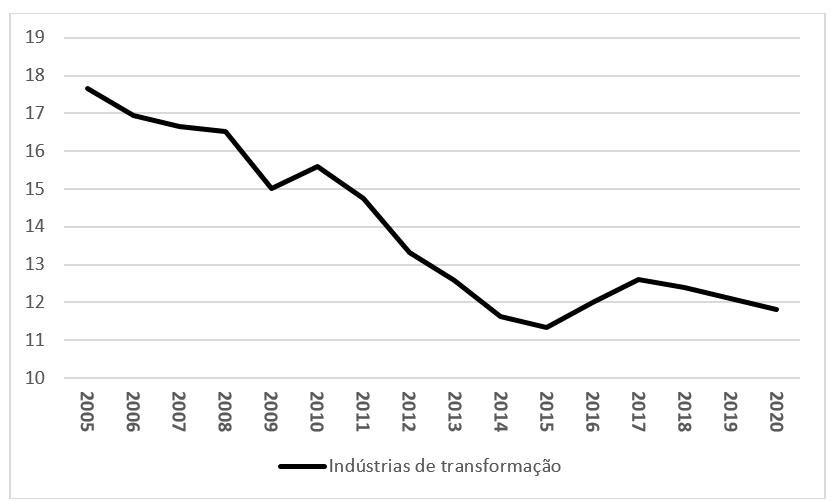
Figure 1. Gross value added, % of total. Source: IBGE. (Black = Manufacturing industries)
The message this graph conveys is, I believe, intuitive: the importance of the manufacturing industry–the economic sector most strongly linked to sustainable development and the improvement of a population's standard of living, given the large productivity and innovation gains associated with it and due to its multiple upstream and downstream linkages in a country's economic structure–has decreased by a third in a period of just fifteen years.
Industrialization has been the great guiding principle of economic development in Brazil during the 20th and 21st centuries, now, as was the case throughout the Latin American region, a process supported by analyses produced (see Prebisch 1950) by the United Nations Economic Commission for Latin America and the Caribbean, or ECLAC (I will be transparent here, confessing that I began my career as an economist at ECLAC itself).
The policies suggested and implemented during this period should be seen as a specific type of industrial policy in which relations with foreign partners were explicitly taken into account when defining domestic policy actions: it is important to emphasize that this did not imply isolation or autarky–which is profoundly detrimental from the point of view of development–but rather a strategic reflection on the options any country has for interacting with its potential external partners. This fundamental principle of national development has been integrated into Brazilian policies, in one way or another, at least since the Getúlio Vargas government in the 1930s, involving successive generations of large investments in industry and infrastructure–including by Brazil's external partners–and a very significant political commitment supported by efforts at both the federal and state levels. [2]
Continuing with the story I began this article with, at the same meeting, I showed the graph below (see Figure 2), after which a discussion began about some of the outstanding elements of the agreement.
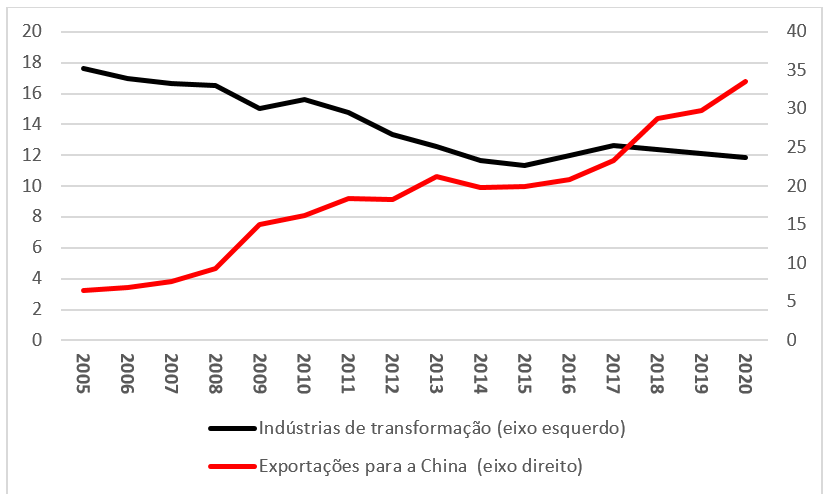
Figure 2. Gross value added and exports to China, % of total. Note: “China” here refers to mainland China, plus Hong Kong and Macau. Source: IBGE, BCB. (Black = Manufacturing industries (left axis); Red = Exports to China (right axis))
Now, the graph above is naturally illustrative, not necessarily implying causality; the fundamental point is that there are different ways for Brazil to further integrate into the global economy, with very different–and even opposite–consequences for the Brazilian economy. These options (and they are indeed options, and not mutually exclusive options) should be evaluated, debated, and chosen by the Brazilian people and their elected representatives, using as a basis the national interest and the well-being (current and future) of the Brazilian nation, as Brazil engages in a dialogue of equals with its partners.
HOW HAS BRAZIL PREVIOUSLY BENEFITED FROM ITS RELATIONSHIP WITH THE EU?
The preceding graphs were used to illustrate a very important point in economic policy, namely, that not only the scale but also the nature of integration into international trade are important for sustainable development. Trade flows that focus primarily on raw materials and agricultural products usually have limited effects on development, with reduced creation of added value and employment domestically, and limited domestic value chains that operate as isolated "islands" within a nation's economic fabric.
In other words, even large (and growing) trade flows with any partner can eventually be detrimental to long-term development if they are based solely on the export of raw materials, leading to deindustrialization and low, unstable growth rates, especially in the absence of compensatory structural policies.[3] It turns out that Brazilian exports to the EU are much more diversified and have a much larger manufacturing component–including sophisticated products such as automobiles–than those destined for other regions of the world, which, in some cases, can consist of up to 60% raw materials (see Figure 3).
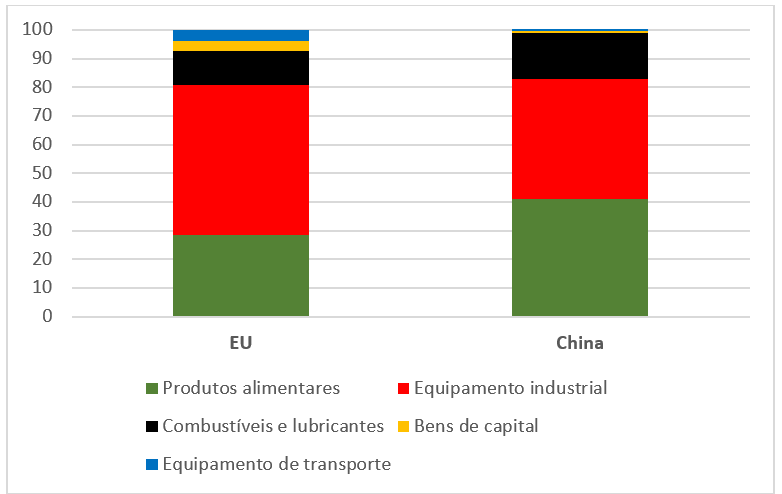
Figure 3. Sectoral composition of Brazilian exports to selected markets, 2021, %. Sources: COMTRADE (for China) and COMEXT (for the EU). (Green = Food products; Red = Industrial equipment; Black = Fuels and lubricants; Yellow = Capital goods; Blue = Transportation equipment)
Furthermore, trade and foreign direct investment (or FDI) should more accurately be considered as complementary elements, rather than separate things: this is because a foreign investor can take advantage of a country's comparative advantages (e.g., large domestic market, abundance of raw materials, low energy and labor costs, etc.) to not only produce for domestic consumption in a country, but also for export abroad, in addition to building infrastructure and bringing innovation and modern technologies to the recipient country.
Now, the EU is historically the largest source of FDI for Brazil: of the nearly $900 billion in FDI accumulated in Brazil, almost 60% comes from the EU (see Figure 4). Not only does no other country or region come close to this accumulated stock of investment from the EU, but its leading position has been reinforced over time. Furthermore, more importantly, these EU FDI flows have, in fact, supported the development of modern industrial sectors in Brazil, from automobiles to renewable energy.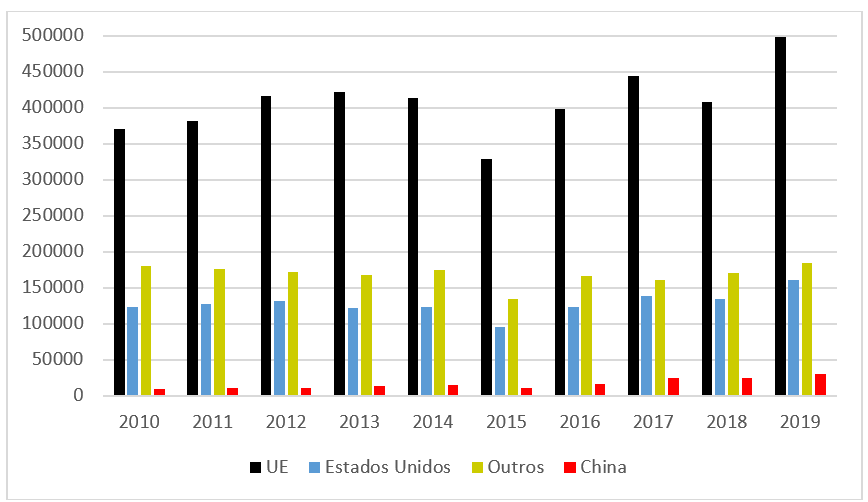
Figure 4: Value of FDI stock in Brazil by national origin (in millions of $). Note: “China” here refers to mainland China, plus Hong Kong and Macau. Source: IBGE, BCB. (Black = EU; Blue = United States; Yellow = Others; Red = China)
I want to be clear that what has been said above obviously does not mean that Brazilian development should not involve a significant component of natural resources: of course it should, this is inevitable, this is one of Brazil's greatest comparative advantages, given the enormous endowment of natural resources that the country has, and it can be beneficial, if done properly and sustainably, in parallel with the development of other sources of growth, and with safeguards in terms of appropriate regulatory and compensatory policies.
WHAT MORE CAN THE EU OFFER BRAZIL IN THE FUTURE?
This is a year of transitions and new beginnings for Brazil. I will illustrate where this multifaceted, strong, and long-standing relationship can take advantage of this window of opportunity, returning to just one specific example, the one I used at the beginning of this article: the EU-Mercosul agreement (which, incidentally, is composed not only of the free trade agreement concluded in 2019, but also of a "Partnership and Cooperation Agreement," which is the political and cooperation pillar, concluded in 2020).
The graphs I used in the initial part of this article aimed to convey to readers that economic relations with the EU, through trade and FDI, have historically been beneficial to both parties, particularly to Brazil, supporting its economic development and industrialization.
This is due to the nature of the EU as a partner: a developed, large and open market, anchored in respect for the law, with high environmental, labor and consumer protection standards and highly innovative and technologically advanced companies. The EU-Mercosul agreement is an additional tool that allows for further strengthening the positive aspects of the relationship.
So, concretely, how? Firstly, by allowing an increase and diversification of bilateral trade and investment in even more advanced sectors, reducing tariff and non-tariff barriers, particularly for small and medium-sized enterprises, thus opening up the Brazilian economy, which is still very closed, generating potentially significant productivity and innovation gains (Mendez-Parra et al. 2022), and related to this, the agreement even has the capacity to make Mercosul itself more internally integrated. Furthermore, and probably even more importantly in the long term, the agreement goes far beyond simple tariff reduction, including liberalization in financial and transport services, more robust intellectual property rights, better food safety standards, competition, trade facilitation, labor and environmental protection: these are all elements that go far beyond those found in traditional trade liberalization agreements (Dadush & Baltensperger 2019).
CONCLUSIONS
Like any other country, Brazil can–and should–freely choose among the many options it has for international relations, economic or otherwise. It should also do so in a way that maximizes Brazilian national well-being, now and in the future, while respecting international commitments and regulations that benefit us all. When evaluating Brazilian options in these terms, a future push towards even stronger and deeper EU-Brazil ties is clearly in Brazil's interest (and, indeed, in the EU's).
Notes
[1] None of the statements in this work necessarily reflects the official positions of any institution with which this author is or has been associated.
[2] Brazil (formally, the "Federative Republic of Brazil"), as a federal nation, has federal states that possess significant tools and room for maneuver to design, implement and support economic policies in general.
[3] There is a long literature on the negative effects of a development model based on natural resources, generally referred to as the "resource curse" or "Dutch disease"; for example, see Mikesell (1977).
References
Prebisch , R. 1950. The Economic Development of Latin America and Its Principal Problems. New York: United Nations. https://repositorio.cepal.org/bitstream/handle/11362/30088/S4900192_en.pdf
Mikesell, R. 1977. “Explaining the Resource Curse, with Special Reference to Mineral Exporting Countries.” Resources Policy 23 (4): 191–199. https://doi.org/10.1016/S0301-4207(97)00036–6.
Mendez-Parra, M., Garnizova, E., Baeza Breinbauer, D., et al. 2022. Sustainability impact assessment in support of the association agreement negotiations between the European Union and Mercosur: final report. Publications Office of the European Union, European Commission, Directorate-General for Trade. https://data.europa.eu/doi/10.2781/54752 .
Dadush, U. & M. Baltensperger. 2019. “The European Union-Mercosur Free Trade Agreement: Prospects and risks”. Bruegel, September 24, 2019. https://www.bruegel.org/policy-brief/european-union-mercosur-free-trade-agreement-prospects-and-risks .
Received: February 14, 2023
Accepted for publication: May 12, 2023
Published on May 17, 2023. Updated on June 15, 2023.
Translation published: July 13, 2026
* Translated by Theo Pereira with the support of digital machine translation tools: Google Translate (initial draft), Grammarly (grammatical and syntactic revision), and ChatGPT (selective phrasing refinements). Reviewed by the author.
Copyright © 2026 CEBRI-Revista. This is an open access article distributed under the terms of the Creative Commons Attribution License, which permits unrestricted use, distribution, and reproduction in any medium, provided the original article is properly cited.
