
-

-

-
 PT | EN
PT | EN 
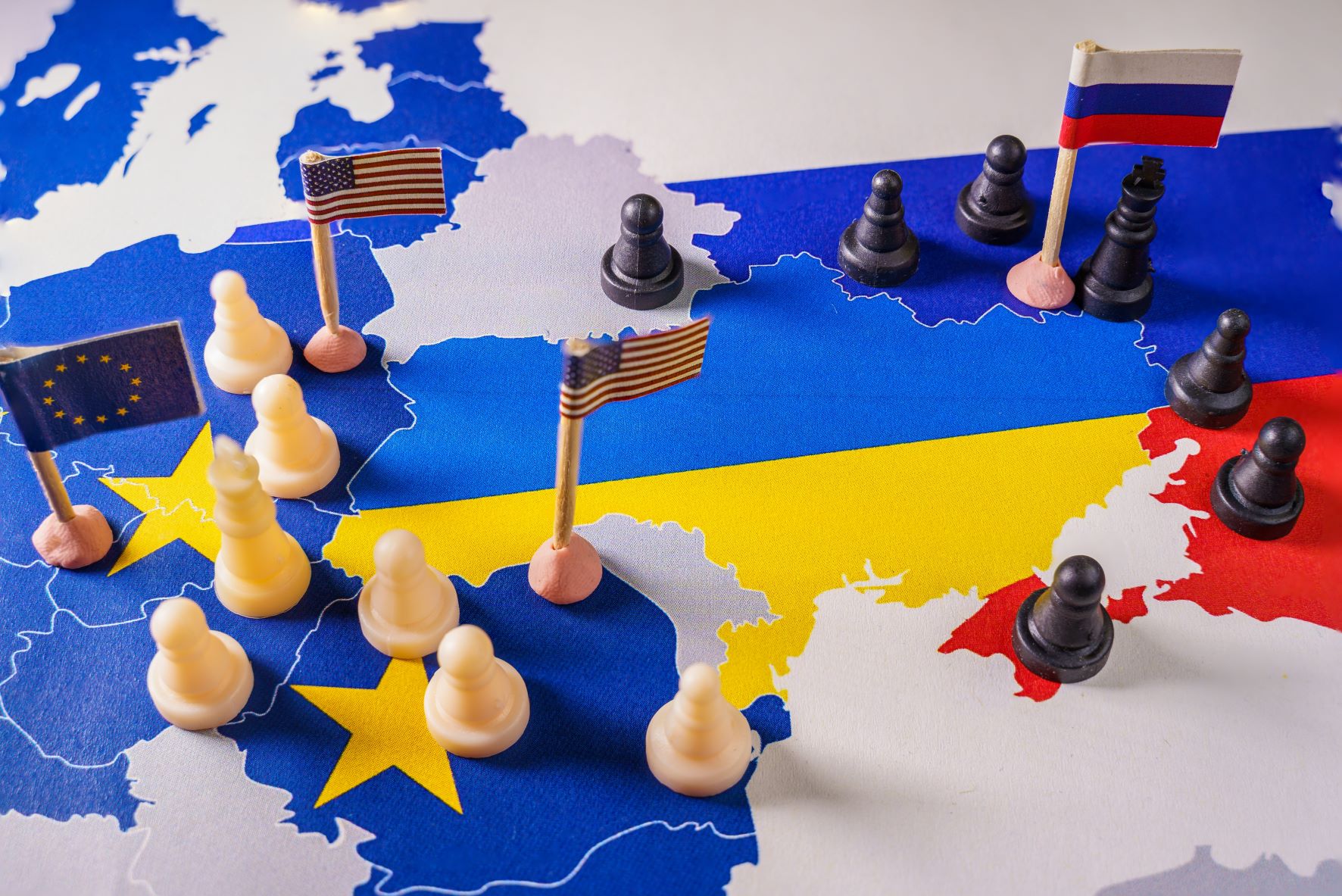
Russia's armed offensive against Ukraine is the visible face of a much more complex and orchestrated strategy, which was preceded by a lengthy campaign of disinformation and fake news, aimed at diverting public opinion from what would be the largest military operation in Europe in the 21st century, in total disregard for the principles of international law, the letter of the Charter of the United Nations, and commitments such as those expressed in the Budapest Memorandum of 1994. On that occasion, Russia, the US, and the UK offered guarantees of respect for the sovereignty and integrity of Ukrainian territory, in the context of the return to Russia, by the Kyiv regime, of the Soviet nuclear arsenal located in the country.
Despite this, much of the international community initially preferred to carry the principle of non-intervention in the internal affairs of states to extremes, even in the face of the obvious threat to Ukraine's territorial integrity and independence, in stark contradiction to Article 2.4 of the UN Charter. They preferred to debate the numerous and varied arguments manipulated by President Putin to "justify" his planned invasion of Ukraine and reconfiguration of the geopolitical map of Europe. This campaign, consistent with the purposes of a "hybrid war," had the same effect as decoys launched by aircraft when invading enemy airspace, by creating magnetic interference capable of scrambling radar readings and making target identification impossible. The world's attention was thus practically hypnotized by the Russian leader's discourse, although it seemed impossible to ignore the fact that the unprecedented mobilization and deployment of troops and military equipment on the border with Ukraine represented, since the beginning, an effective instrument of intimidation and coercion of the neighboring country.
The world wasted precious time discussing baseless allegations, such as the extravagant accusations of Ukrainian threats to Russia (reminiscent of the fable of the Wolf and the Lamb), the characterization of the Zelensky government as "Nazi" (when Ukrainians and Russians are known to originate from the same Slavic ethnic group), and the notorious historical distortions in Putin's insinuating speech of July 12, 2021, about the existence of a "triune state" comprised of Russia, Ukraine, and Belarus. A paradoxical "war of narratives," given the vast arsenal of information now available to everyone and the extensive media coverage of events. To trace the origins of these narratives, one would have to examine President Putin’s background as a KGB officer in the Soviet era. From this perspective, one can better understand his attachment to the concept and practice of "limited sovereignty", imposed by force on the countries of Eastern Europe at the time, mostly for "deviations from the Soviet line" (such as the anti-communist uprising in Hungary in 1956 and the Prague Spring in 1968), pretexts invoked to justify the USSR's "internationalist duty of intervention" (an euphemism for wars of repression and expansion). Add to this the persistence, albeit subliminal, of the imperial mentality, echoed in Catherine the Great’s dictum, for whom "the only way to defend my borders is by expanding them" (to which the conventional wisdom added "Russia ends where the Russian language ends"). In this sense, Putin's vehement denial of Ukraine's existence is also consistent with the Kremlin's doctrine of systematically combating the idea of "nation," insofar as it operated against the interests of Soviet internationalism and, ultimately, Russian hegemony. Symptoms already identified by the American diplomat and strategist George Kennan during his time at the embassy in Moscow in 1946, when he stated in his Long Telegram that the USSR could not maintain "a permanent peaceful coexistence with the West" as a result of its "neurotic view of world affairs" and the "instinctive Russian feeling of insecurity."
In this context, the demand to revert NATO to its pre-1997 positions suggests that the Russian president seeks to reactivate the understandings reached at Yalta in February 1945 by Stalin, Roosevelt, and Churchill to define zones of influence among the victors, under radically different circumstances from those of the present. Today, after the consolidation of a new geopolitical framework, with the incorporation of the Eastern European and Baltic countries into NATO, without this resulting in any real threat to Russia's security, the proposal sounds untimely and revanchist. Even more so when it is unexpectedly extended to Finland and Sweden, which reveals, without any ambiguity, that the intention is to apply the concept of "limited sovereignty" to the countries he considers within his "sphere of influence," condemned, by Putin's logic, to become "buffer states" between Russia and Europe. NATO's restraint, both now and during the independence referendums in Georgian provinces in 2008 and in Ukraine in 2014, reaffirms the Alliance's defensive character. Its mistake may have been to announce an "open door policy," thereby inducing the population and interested governments to harbor unfounded expectations and to misjudge the risks of potential military action. Ukraine and Georgia had, from the outset, very slim chances of becoming NATO members, due to their undeclared war with their neighbor, the disputed territories within their borders, and, lastly, an unfortunate geopolitical fatalism. In the case of Ukraine, aggravated by the presence of a foreign military base (the Russian naval base in Sevastopol, Crimea).
Similarly, regarding the EU, Ukraine would have to comply with the basic requirements set out in the “Copenhagen criteria” of 1993, which include the problematic stability of its political and economic institutions in the aftermath of the war and its capacity to incorporate and comply with the EU legal acquis. Furthermore, Ukraine would jeopardize the functioning of one of the cornerstones of European unity, the costly Common Agricultural Policy (CAP), by incorporating one of the most competitive countries in this sector. Entry into the attractive economic club is thus compromised by the potentially affected interests of the Europeans themselves and by the high levels of Russian energy supplies to Europe (which will tend to regain political importance when public opinion wanes, due to the passage of time and the presumption that Germany and its partners will not find reliable alternative sources in the medium term). Preserving the Ukrainian economy within the Russian sphere of influence will condemn it to stagnation and virtually eliminate its chances of recovery. To make matters worse, unlike during the Cold War, Russia offers Ukraine no attractive political, ideological, or economic advantages, due to its increasingly authoritarian regime, significant state intervention in the productive sector, and its status as an exporter of energy and agricultural commodities (in which they compete).
That being said, anyone who studies the history of the region will easily identify that Russia "was born" from the diaspora of contingents from the largest state in medieval Europe, between the 9th and 13th centuries, the Kiev Rus. This principality, which reached its peak under Vladimir the Great (980-1015), established Orthodox Christianity, which is still prevalent in Ukraine and Russia. After the death of his son, Yaroslav the Wise (1019-1054), the Rus went through a long period of internal struggles and Mongol invasions. As a result, its nobles moved to other regions, such as Moscow, which became the new hegemonic center. In other words, the Kiev Rus, with its beautiful monasteries from the 11th and 12th centuries, has an undisputed historical precedence over the others, and its existence was recognized (and not "invented") by Lenin, as suggested by Putin. On the other hand, the need to protect "ethnic Russian groups" in Ukraine is a play on words, considering that the Old Continent, a traditional area of emigration, adopts jus sanguinis, whereby citizenship is determined by the nationality of the paternal or maternal ancestors of new generations (unlike Brazil and the New World, which adopt jus soli, which considers those born in the country as nationals). The Russification imposed by the Russian Empire on its domains since the 18th century and the location of Russians in eastern Ukraine – in the wake of the demographic void caused by the “Great Famine” of 1932-1933 (Holodomor), imposed by Stalin to promote the forced collectivization of agriculture – make the presence of “ethnic Russians” in the region inevitable (as much as that of “ethnic Portuguese” in Brazil). This argument would not, however, have the weight it does if, since 2003-2009, Russia had not, according to repeated accusations from the Ukrainian government at the time, promoted frequent "consular missions" to offer Russian passports and citizenship to the population of Eastern Ukraine, in preparation for the current war scenario.
Whatever the outcome of the war, the Russian invasion has already had a predictable impact and effect on international relations. In the political arena, it has once again exposed the limits of UN action, due to the veto power of the five nuclear powers.
Whatever the outcome of the war, the Russian invasion has already had a predictable impact and effect on international relations. In the political field, it has once again exposed the limits of UN action, due to the veto power of the five nuclear powers. The UN nevertheless proved to be an important forum for the expression of the international community’s collective judgement, as evidenced by the overwhelming condemnation of Russia as an "aggressor state”. The crisis fostered a surprising consensus among European countries, extending to issues that had previously resisted consensus in the recent past, such as the decision to restrict gas and oil imports from Russia and Germany's agreement to deactivate the Nord Stream 2 pipeline, which would have provided more fuel to its territory and neighbors. As a result, an acceleration in the search for alternative energy sources is to be expected, in line with the objectives already agreed upon in environmental policy. NATO, which had been threatened with troop withdrawals and cuts in contributions by the American government during Trump's presidency, also acted with a single voice and recovered its prestige as an instrument of collective defense. However, it also brings a renewed climate of belligerence and the rearmament of Germany. The Russian military action, in turn, diverted the US focus from its disagreements with China, which signed an alliance with Russia of still unknown scope. China has economic interests that, in the short term, transcend its gains from the disruption of security in Europe, its preferred market. In the economic sphere, the disruption of large supply chains stimulates reshoring for security reasons and, secondarily, will tend to reinforce developmentalist currents favorable to old policies, such as import substitution and the relaunch of the same old "national champions" policies. Ultimately, however, economic logic will likely prevail and globalization will resume its previous course, even if with difficulties. Meanwhile, the world will suffer from rising commodity prices, inflation, and lower economic growth. Finally, the large influx of refugees will force Europe to resize its support programs and to seek the difficult task of accommodating these new contingents within its productive structure.
All things considered, the Russian offensive has yet to show how far it intends to go. The damage already done leaves no doubt about the initiative's expansionist objectives.
All things considered, the Russian offensive has yet to show how far it intends to go. The damage already done leaves no doubt about the initiative's expansionist objectives. As the situation stands, the only remaining option to rule out is to keep the entire country under occupation, given its high military, economic, and political cost, in the face of the inevitable exacerbation of nationalist sentiments and the Ukrainians' refusal to abandon their self-proclaimed European vocation. The resulting frictions would lead to serious political instability, with risks of terrorist attacks, guerrilla actions, and other forms of self-defense. Since Russian forces are not sufficient to secure the third stage of an invasion–control of the civilian population–the most likely alternative would be the installation of a puppet government of uncertain duration. It is unclear where Russia will draw the lines for any potential new annexations, which, even if restricted to the east, would cause a radical disruption of the country's industrial base (since its coal mines, steel mills, turbine factories, blast furnaces, tractors, and space industry are concentrated there). If it includes the ports of Mariupol (on the Sea of Azov) and Odesa (on the Black Sea), through which exports of steel, fertilizers, wheat, and food products flow, it would strangle the economy and make the country unviable. What will be acceptable to both sides when they sit down at the negotiating table, considering that Putin cannot relinquish his claims to victory and Zelensky cannot make concessions that suggest that all the resistance efforts were in vain? Whatever the outcome, it will have a high cost in innocent lives, defenders of their homeland, and human capital for the future. In conclusion: the generous aid that the West has been offering to the country is destined for which "Ukraine"?
Rio, March 28, 2022
References
Boundless World History. s.d. “The Cold War – The Long Telegram.” History of Western Civilization. OER Services. Acessado em 7 de fevereiro de 2021. https://courses.lumenlearning.com/suny-hccc-worldhistory2/chapter/the-long-telegram/.
Putin, Vladimir. 2021. “Sobre a unidade histórica de russos e ucranianos.” Ensaio, 12 de julho de 2021. htpp://kremlin.ru/events/presidente/News/66181.
Received: March 28, 2022
Accepted for publication: March 28, 2022
Translation published: August 8, 2026
* Translated from Portuguese by Theo Pereira with the support of digital translation and AI-assisted language tools: Google Translate (initial draft), Grammarly (grammatical and syntactic revision), and ChatGPT 6 (selective phrasing refinements). Reviewed and approved by the authors. AI assistance is disclosed in line with the guidelines of CNPq Ordinance No. 2,664 of March 6, 2026 (Brazil).
Copyright © 2022 CEBRI-Revista. This is an open access article distributed under the terms of the Creative Commons Attribution License, which permits unrestricted use, distribution, and reproduction in any medium, provided the original article is properly cited.
